The first shock came in April
Before the conflict in the Middle East, diesel cost Australian operators about A$1.80 a litre. By April it had reached a record A$3.20. In trucking, fuel sits alongside wages as one of the two largest costs, so a rise of that size is not a nuisance at the margin. It changes the economics of every contract, every route and every quote on the books.
The speed made it worse. Within six weeks of the first strikes on Iran, pump prices had risen by more than 70%. Most rate agreements in road freight are reviewed quarterly or annually, if they are reviewed at all, and many smaller operators have no fuel adjustment clause. Fuel is paid for at the pump every week, while customers pay on 30 to 60 day terms. Even operators with good customers found themselves funding the gap from their own cash.
Many operators got through the first months the only way they could. They absorbed what they could not pass on, stretched suppliers, deferred maintenance and agreed payment plans with the ATO, hoping the spike would be short. For some that was enough. For others it was not, and the insolvency figures through the year reflect it.
The question we are now asking, and that owners and their advisers should be asking too, is whether a second wave is on its way. The evidence suggests it is, and that it will look different from the first.
Oil and diesel since February
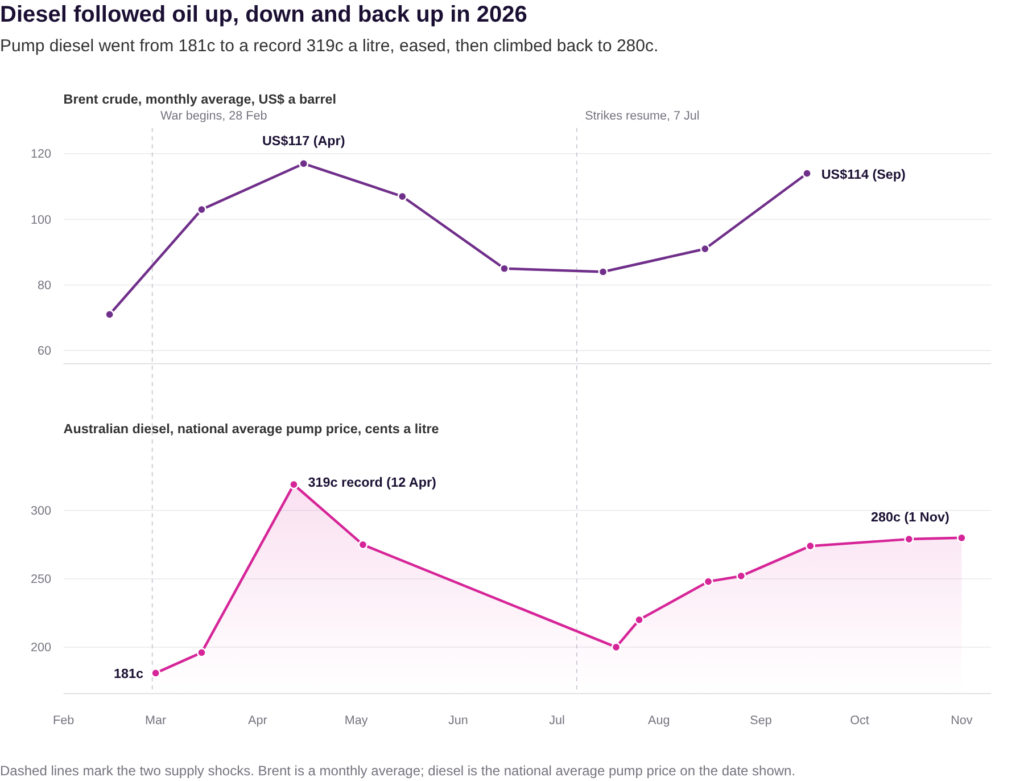
Sources: Brent, EIA spot monthly averages via CrudeOilPrice.org (Feb–Sep 2026). Diesel, Australian Institute of Petroleum weekly national averages via AIP reports, ABC and CEIC (1 Mar–1 Nov 2026).
Brent crude averaged about US$71 a barrel in February. Once the strikes on Iran began on 28 February and shipping through the Strait of Hormuz all but stopped, it averaged US$117 in April, with spot prices touching US$138 on 7 April, the highest since 2008 (CrudeOilPrice.org, EIA data). A ceasefire, talks and a June agreement that reopened shipping took Brent back to the low US$80s by July.
The relief did not last. Strikes resumed on 7 July, drones damaged Saudi Arabia's main pipeline around Hormuz in September, and Brent averaged US$114 that month. Australian pump prices followed with the usual lag. The national diesel average hit a record 319 cents a litre in the week to 12 April, eased to about 200 cents by mid-July, and was back at 280 cents in the week to 1 November (AIP via CEIC). That is still about 55% above where it stood before the war.
For operators, the shape of the line matters as much as the peak. A single spike can be absorbed and recovered. Two spikes with a false dawn in between catch businesses that repriced, relaxed or took on new commitments during the dip.
Why a second wave is likely
In late July, Australian Trucking Association CEO Mathew Munro made three points that deserve attention. Trucking was already in a precarious position before the war. The crisis is not over. And diesel prices are rising again. Each point would be a concern on its own. Together, they describe how a second wave forms.
Before the war, the sector was already carrying thin margins, higher interest costs, rising insurance and registration, and in many cases tax debts left over from the pandemic years. The first fuel shock took the businesses with no buffer at all. The operators still standing often got through by spending whatever buffer they had: cash reserves, an ATO payment plan, a loan from a director, a fleet replacement pushed back another year.
That bought time, and in many cases it was the right call. But it leaves the same businesses meeting the next increase with less room than they had in March. Any rate agreed during the June and July dip, when diesel briefly fell back towards A$2 a litre, now looks thin. The payment plan from the first round still has to be met, and trucks that were due for replacement are a year older.
A second rise does not need to be as sharp as the first to do more damage. It lands on businesses that have already used their reserves.
What the July numbers tell us
In July, transport, postal and warehousing recorded 99 insolvency appointments, level with retail and among the four highest industries for the month.
What stands out is the backdrop. Across all industries, first-time insolvencies fell 12.5% on the previous July, to 1,211. Retail, which shared the 99 figure, had come down from 133 a year earlier. A softer headline number can make it look as though pressure is easing everywhere. For transport, it is not.
That gap matters. When one sector holds firm against a falling national trend, it usually points to a cause specific to that sector rather than to the wider economy. In transport, the cause is easy to name.
It is also worth remembering that insolvency figures lag reality. An appointment in July usually reflects cash shortfalls and decisions made three to six months earlier, which in this case means the April peak. The renewed rise in diesel since July has not yet worked its way into the numbers.
What the sector is saying
The industry has been sounding the alarm all year, and the coverage shows how the pressure has shifted from a sudden shock to a longer grind.
- April: A National Road Transport Association survey found more than 70% of operators feared they would not survive the next six months. The Fair Work Commission responded with an emergency order requiring supermarkets, miners, retailers and other clients at the top of the chain to cover operators' higher fuel costs .
- May: The Guardian reported that truckies were already struggling to survive before the crisis, with diesel jumping from about A$1.80 to a record A$3.20 a litre.
- June and July: Diesel eased below A$2 a litre in early June and the Fair Work obligations switched off. By mid-July prices were climbing again. Australian Trucking Association CEO Mathew Munro warned the crisis was not over as he called for fuel tax relief to stay in place.
- September: Diesel was again nearing A$3 a litre in parts of the country. The government ruled out another fuel tax cut, and the Queensland Trucking Association said members could no longer fund fuel on behalf of the rest of the supply chain.
- October: The Fair Work Commission decided to switch its fuel cost recovery order back on. It found that owner-drivers and small fleets remain in a weak bargaining position and still struggle to recover higher fuel costs .
That October decision is the clearest official signal yet that the second round of pressure is real.
Small operators feel it first
The pattern is one we see often. A small fleet, often family-run and often in its second or third generation. Fuel is paid weekly at the pump, and surcharges, where they exist, are recovered a month or more later. A large share of revenue comes from one or two customers, which makes it hard to push back on rates. And there is little room to turn down work that no longer pays, because a truck that sits idle still carries lease payments, insurance and registration.
Small operators are rarely the least capable in the market. Many run tight, efficient businesses and know their costs better than larger competitors do. They simply have the least room to wait, and fuel shocks reward time above almost everything else. A large fleet can hedge, carry a surcharge lag for a quarter, or renegotiate from strength. A five-truck business usually cannot.
Who will feel it first
Not every part of transport carries the same risk. Road freight operators were averaging net margins of around 3% before the war, so the question is who can pass costs on and who cannot. On that basis, this is the order in which we expect the pressure to show up:
- Owner-drivers and subcontractors. They sit at the bottom of the contract chain with the least bargaining power. The TWU told the Fair Work Commission that fuel had risen from about 30% to 60% of owner-drivers' costs.
- Small regional, rural and livestock carriers. Long distances, higher regional fuel prices and supply interruptions hit them hardest. Livestock and rural transporters reported regional rationing and margins already stretched thin.
- Tipper and civil construction haulage. Civil construction is the economy's most diesel-dependent sector, and much of its work sits on fixed-price contracts with no rise-and-fall clause.
- Small and mid-sized general freight fleets. Operators with older trucks, heavy reliance on one or two customers and an ATO debt from the first round have the least room left.
- Container and port cartage. Most operators already recover fuel through a separate surcharge. They are better protected, but still carry the cash gap between paying at the pump and being paid by customers.
Larger national fleets with hedging, indexed contracts and diverse customers sit at the end of the queue. They are not immune, but they have the most time.
What it means in dollars
Percentages can hide how quickly this adds up. The three examples below use round, illustrative numbers and compare the pre-war national average of 181 cents a litre with 280 cents today. With GST removed, that is a rise of about 90 cents a litre. Fuel tax credits do not change this picture, because the credit is a fixed amount per litre and does not move with the pump price.
An owner-driver on linehaul. One prime mover covering 200,000 km a year at 55 litres per 100 km burns about 110,000 litres. At the pre-war price, that fuel cost roughly $181,000 a year before GST. At today's price it costs about $280,000. The extra $99,000 works out to around $1,900 every week. On turnover of about $400,000, fuel has gone from under half of revenue to around 70% of it. If the rate per kilometre has not moved, almost all of that increase comes straight out of what the owner takes home. At April's peak, the weekly hit was closer to $2,650.
A five-truck regional fleet. Five trucks at 150,000 km a year each use about 412,500 litres. The extra 90 cents a litre adds roughly $372,000 a year, or about $7,150 a week. On $3 million of revenue at the industry's typical 3% net margin, annual profit is about $90,000. The fuel increase alone is four times that. Timing matters too. If the fuel surcharge is reviewed monthly in arrears and customers pay on 30-day terms, the business pays about eight weeks of higher fuel before it sees the money back. That is around $57,000 of working capital tied up, even when the surcharge recovers every cent.
A tipper contractor on a fixed-price civil job. Four tippers each using about 400 litres a week burn 83,200 litres over a 12-month contract. The job was priced in February at $1.6 million with a 4% margin, about $64,000 of profit. The extra fuel cost over the year is about $75,000. Without a rise-and-fall clause, a profitable job becomes a loss of around $11,000. That is before any increase in bitumen, pipe or other oil-linked materials.
None of these businesses is badly run. Each one simply has a cost it cannot control growing faster than the income it is contracted to receive. For an owner-driver it shows up in the weekly bank balance. For the fleet it shows up in working capital, and for the contractor in a contract that was signed in good faith at the wrong time.
The signs to watch for
Businesses rarely fail overnight. In transport, the early signs tend to look like this:
- Surcharges that lag or are refused. If fuel surcharges trail the pump price by a month or more, or customers simply won't accept them, the business is in effect lending money to its customers.
- Rates set during the dip. Agreements struck in June and July, when diesel briefly eased, with no rise-and-fall clause to protect them.
- A second round of ATO trouble. A payment plan agreed after the first shock that is now slipping, or new BAS debts building on top of it.
- Super and PAYG falling behind. These are often the first obligations quietly deferred, and they carry personal risk for directors through director penalty notices.
- Deferred maintenance and registration. Keeping trucks on the road by putting off servicing creates safety and compliance risk, as well as a bigger bill later.
- Owners funding the business personally. Directors covering fuel or wages from their own accounts or a home loan is often the clearest sign the business can no longer fund itself.
One of these on its own is manageable. Two or three together is the point to stop and look closely, ideally with someone independent. In our experience, these signs usually show up in the management accounts three to six months before a business reaches a crisis. That window is where the real options are.
What owners and directors can do now
- Run the numbers at today's price. Build a 13-week cash flow using the current diesel price, not the average of the past few months. Then test it at 20% higher, and again at a level close to April's peak. If the business only works at the prices of a few months ago, you need to know that now, while there is still time to act.
- Talk to customers before the next invoice. Put fuel indexation on the table, tied to a published benchmark such as the AIP weekly average and reviewed at least monthly. Show customers the numbers openly. Most would rather renegotiate than lose a reliable carrier. If you carry for large clients, the revived Fair Work fuel cost recovery order may require them to share the cost.
- Engage the ATO early. If a payment plan from the first round is under strain, contact the ATO before an instalment is missed. A conversation before a default goes very differently from one after it, and keeps more options open.
- Understand your position as a director. Directors need to know whether the company is solvent, what personal exposure they carry for unpaid super and PAYG, and whether safe harbour protections could support a genuine turnaround plan. Those protections only apply if the right steps are in place first, including employee entitlements paid and tax lodgements up to date.
- Get an independent view while there are still choices. Refinancing, selling surplus trucks, restructuring the fleet or the debt, a small business restructuring or a voluntary administration: every option is wider and cheaper earlier. Waiting rarely improves the menu.
Acting early
Behind each of those 99 appointments is a business someone built, drivers who relied on it and customers who now need another carrier. Many of those outcomes were decided months before the appointment, in the gap between noticing the pressure and acting on it.
The operators who come through a second wave are rarely the ones with the lowest costs. They are the ones who looked at their numbers early and honestly, and acted while they still had choices.
If you run a transport business, or advise one, and would like a steady, independent view on where things stand, we're always happy to talk.
Sources
- Insolvencies soften in new financial year, Ragtrader, citing ASIC data for July 2026
- Price data: EIA Brent monthly averages via CrudeOilPrice.org and AIP weekly diesel prices via CEIC.
- Worked examples use illustrative assumptions, not client data.