
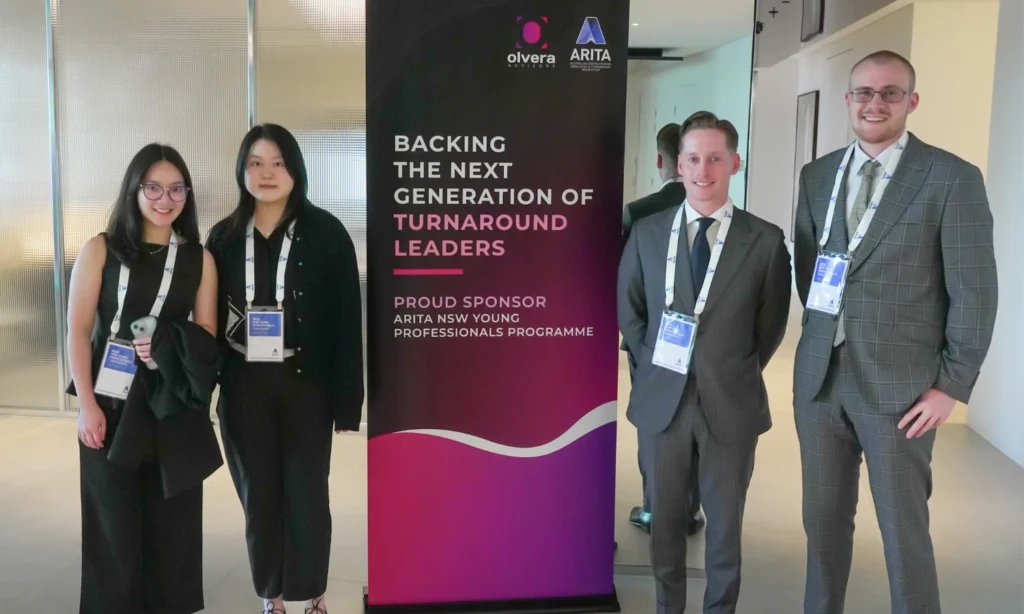
ARITA NSW Young Professionals Conference 2026
Olvera is proud to have recently commenced its three‑year sponsorship of the ARITA NSW Young Professionals Programme, an initiative dedicated to developing the next generation of leaders within the restructuring, turnaround and insolvency profession.
The programme’s first major event for the year - the Young Professionals Conference - was hosted at the Sydney office of Pinsent Masons, bringing together emerging professionals from across the industry for an afternoon of insights, discussion, and connection.
Four members of the Olvera team attended the conference and came away with valuable perspectives across key areas shaping the future of the profession.
Private Credit: A Growing Force in Australian Markets
The conference opened with a deep dive into private credit, an area that continues to play an increasingly important role in Australian business and project funding.
Led by David Kenney (Partner, EY-Parthenon), the session provided a strong overview of the private credit landscape and its evolution in Australia. This was followed by perspectives from industry participants, including Directors Elliot Etheridge and Vivian, who shared practical insights from within the market.
A particularly valuable dimension of the discussion came from ASIC, with a Senior Executive Leader outlining the regulator’s perspective. Key themes included:
- The rapid growth of private credit in Australia relative to global markets
- The notable involvement of retail investors in the domestic landscape
- Ongoing challenges arising from the lack of formal definitions and consistent frameworks within the sector
Gabriel Truscott, one of our attendees, noted: "We got to see multiple perspectives on the subject, from the regulatory body's view on how Australia differs from international markets to the practical experience of directors operating in the space."
Jesse Moy added that the session "provided good insight into the lender's perspective as well as ASIC's current focus in the private credit market," though he felt the connection to restructuring and insolvency work became clearer during the question time.
Determining the “True Employer”: Lessons from Mosaic
The second session focused on one of the more technical, but highly practical, aspects of restructuring: identifying the “true employer” in complex corporate structures.
Presented by Amanda Coneyworth (KPMG) and Kelli Johnston (Department of Employment and Workplace Relations), the discussion centred on the Mosaic case study, providing tangible insights into how liquidators approach these determinations.
Key takeaways included:
- The importance of understanding operational control versus contractual arrangements
- Indicators that may suggest an entity is the true employer in substance, not just form
- Practical considerations for insolvency practitioners when assessing employee claims and entitlements
The session provided attendees with a grounded, real‑world example of how these issues arise and are resolved in practice, reinforcing the importance of careful analysis in complex engagements. "It showed real insights from the matter of Mosaic and provided tangible signals to look for," Gabriel observed.
The Future of Insolvency: Evolving Skills and Opportunities
The conference concluded with a forward‑looking panel discussion on the future of the insolvency and restructuring profession.
Featuring Phoebe Martin (Pinsent Masons), Louisa Sijabat (Merchants Advisory), and Erica Xu (Grant Thornton Australia), and moderated by Marc Bosnic (Johnson Winter Slattery), the panel offered a range of perspectives on how the industry is evolving.
Themes explored included:
- The increasing breadth of skills required beyond traditional insolvency expertise
- The growing importance of stakeholder management, commercial acumen and strategic thinking
- The role of technology and data in shaping future advisory work
- Practical advice for young professionals looking to build sustainable and rewarding careers in the industry
There was discussion about the impact of AI on the industry. While AI will play an increasing role, the consensus was that the industry will remain people driven, with AI serving as a tool to assist. This reinforced that the profession is moving beyond purely transactional or compliance‑driven work, toward more strategic, advisory‑led engagements.
The panel discussion proved particularly interesting for our attendees, with engaging speakers who generously shared their knowledge with young members of the profession about their experiences and advice for progressing their careers in a meaningful way.
Investing in the Future of the Profession
The Young Professionals Conference highlighted both the depth of talent emerging within the industry and the importance of continued investment in developing that talent.
At Olvera, we see strong alignment between our work - supporting businesses through complexity, transformation and distress - and the objectives of the ARITA Young Professionals Programme. Building capability early in careers is critical to the long‑term strength of the profession.
We look forward to supporting the programme over the coming years and continuing to engage with the next generation of restructuring professionals as they develop their skills, networks and perspectives.