

In Australian restructures, a Deed of Company Arrangement (DOCA) frequently delivers a commercial compromise between an insolvent company and its creditors. While the legal mechanics are well understood under the Corporations Act 2001, the income tax consequences of debt forgiveness are often underestimated - particularly the impact on carry-forward tax losses and other tax attributes.
For directors, deed proponents, and advisers, careful structuring of debt terms can materially influence whether valuable tax assets survive the restructure.
The starting point is Division 245 of the Income Tax Assessment Act 1997 (ITAA 1997), which governs commercial debt forgiveness (CDF).
A debt is “commercial” where interest is deductible, or it is otherwise incurred in gaining assessable income.
A “forgiveness” occurs when a creditor releases or waives the debt, accepts less than full repayment, assigns the debt for inadequate consideration or agrees the debt is extinguished under a DOCA.
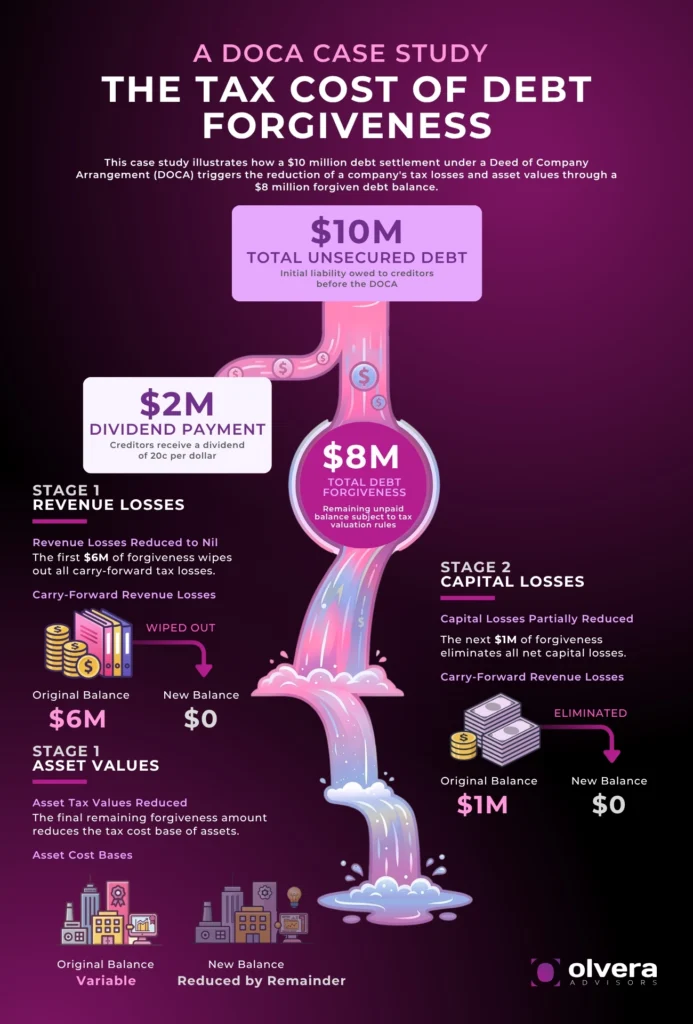
Debt forgiveness is generally not assessable income, but it triggers a reduction of tax attributes.
The net forgiven amount equals Debt value – Consideration given – Excluded amounts. This calculation is critical because it determines the magnitude of tax asset reductions.
Order of Reduction of Tax Attributes
Under Div 245, the net forgiven amount reduces tax attributes in a prescribed order:
- Carry-forward revenue losses (Div 36)
- Net capital losses
- Deductible expenditure pools
- Cost bases of CGT assets
- Depreciating asset tax values
A DOCA that forgives substantial debt can wipe out accumulated tax losses, diminishing future tax shelter capacity when the go forward business could use it most.
Tax Losses Matter
Carry-forward losses often represent a material restructuring asset, especially where the company is recapitalised, the business operations continue and investors rely on post-restructure profitability.
These losses are already subject to two Division 165 tests:
- Continuity of Ownership Test (COT)
- Similar Business Test (SBT) (formerly Same Business Test)
Debt forgiveness introduces an additional erosion mechanism via Div 245.
While Div 245 cannot be avoided artificially, commercial structuring choices can mitigate adverse outcomes, below are four common examples:
Debt-for-Equity Swaps
Instead of outright forgiveness, creditors subscribe for shares in satisfaction of debt. The consideration given will be equal to the market value of equity issued. The swap however must satisfy Div 245 valuation principles, the equity value must be defensible, and the ownership change may trigger Div 165 issues.
Partial Repayment vs Full Release
A DOCA can distinguish the debt compromise (accepting reduced payout) and the timing of the legal release of the debt and therefore the timing of the forgiveness until after profit realisation. Timing is therefore a strategic variable.
Use of Contingent Payments
Structuring consideration as future performance-linked payments or earn-out style recoveries can increase “consideration given” and reduce initial forgiveness amount. In these instances, it must be a genuine commercial arrangements, not tax-driven artifices.
Subordination vs Forgiveness
Creditors may agree to subordinate debt, extend maturity and capitalise interest without immediate forgiveness. No Div 245 event is triggered, and tax losses are preserved. This can be useful where business recovery prospects exist and debt can be repaid over a longer period of time.
Effective Tax Structuring in DOCAs
So, what should you consider when putting together a deed proposal to maximise the value of tax assets. An effective DOCA tax structuring programme needs six elements:
- Early tax analysis alongside insolvency strategy
- Valuation support for impaired debt values
- Coordinated Div 165 and Div 245 modelling
- Commercially robust debt-for-equity mechanisms
- Explicit drafting on forgiveness timing
- Scenario testing of tax attribute survival
Debt forgiveness under a DOCA is not merely a balance sheet adjustment. It is a tax attribute reallocation event governed by Div 245, capable of extinguishing valuable carry-forward losses and altering future tax capacity. A well-structured DOCA with appropriate tax advise can reduce the net forgiven amount, preserve tax assets, improve investor outcomes and enhance post-restructure viability of the business.
In modern restructures, tax assets are economic assets. Their preservation requires the same discipline applied to creditor recoveries, capital structures, and legal risk. Because the real success of a DOCA is not merely survival - it is sustainable, tax-efficient recovery.