

Choose a business turnaround when the business is still viable, cash flow can be stabilised, and you have time to act while you remain in control. Consider voluntary administration when creditor pressure is immediate, the company is insolvent or close to it, and you need a legal pause to restructure or sell. The right choice comes down to timing, and early insolvency services help directors make it before the options narrow.
For Australian directors facing financial distress, the choice between a business turnaround and formal administration is rarely obvious. Neither is a sign of failure. Both are legitimate tools for saving value, but are often misunderstood. Where they differ is in who controls the business, how public the process is, what protection the company gets from creditors, and what it costs.
This guide explains both options in plain terms, compares them side by side, and shows how independent insolvency practitioners help directors decide.
What is a business turnaround?
A business turnaround is a planned recovery that keeps the company trading, with directors retaining control. It usually happens without a formal insolvency appointment, so nothing is recorded on the ASIC register.
A turnaround plan typically combines several of these steps:
- A 13-week cash flow forecast to show where cash is going and when the pressure points hit
- Cost reduction, including exiting unprofitable products, sites or contracts
- Negotiated payment arrangements with the ATO, suppliers and landlords
- Refinancing or new working capital from lenders or investors
- Operational changes to pricing, margins and debtor collection
- Corporate restructuring of group entities, leases or debt
A turnaround works best when the core business is profitable, or can become profitable, especially when problems are caught early. Earlier and quieter intervention most effectively preserves value. Its weakness is that it offers no legal protection from creditors. A single creditor can still issue a statutory demand or wind-up application while the plan is underway.
What is voluntary administration?
Voluntary administration is a formal administration process under Part 5.3A of the Corporations Act. Directors appoint an independent registered liquidator as administrator after resolving that the company is insolvent or likely to become insolvent.
From the moment of appointment, the administrator takes control of the company and directors' powers are suspended. In return, the company gets a moratorium: most creditors, landlords and secured parties cannot enforce their claims without the administrator's consent or the court's leave. Enforcement of directors' personal guarantees is also generally paused during the administration.
The process usually runs for about five weeks and follows a fixed path:
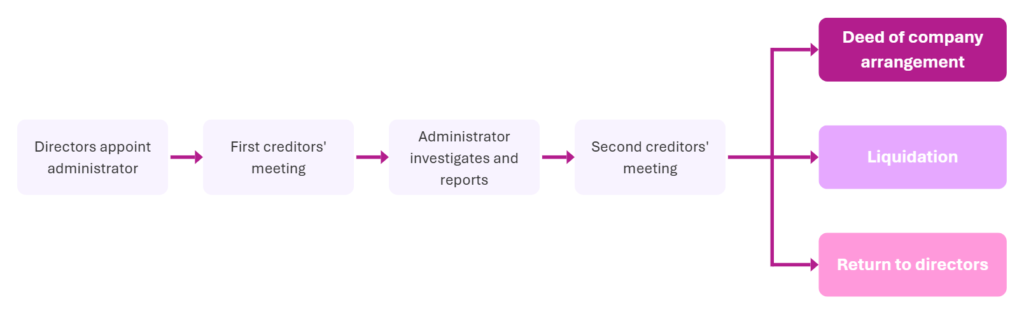
At the second meeting, creditors vote on the company's future. A deed of company arrangement (DOCA) is the outcome that can save the business, often with creditors accepting a partial payment. Returning the company to directors is rare, and liquidation follows if no viable proposal is put forward.
Voluntary administration is public. The company's status changes on the ASIC register, and every public document must show that an administrator has been appointed. That said, stakeholders increasingly see a well-timed administration as responsible: a sign that directors are protecting value, not walking away.
Business turnaround vs voluntary administration: side by side
In practical terms, the trade-off is control and privacy on one side, and legal protection from creditors on the other.
| Factor | Business turnaround | Voluntary administration |
|---|---|---|
| Who controls the business | Directors | Independent administrator |
| Protection from creditors | None, unless negotiated | Statutory moratorium on most claims |
| Personal guarantees | Can still be enforced | Enforcement generally paused during administration |
| Public record | Private | Recorded on the ASIC register |
| Typical timeframe | Months, set by the plan | About 5 weeks to the second meeting |
| Creditor approval | Individual agreements | Majority vote at the second meeting |
| Cost | Advisory fees, usually lower | Administrator's fees, approved by creditors |
| Best suited to | Viable businesses with time to act | Insolvent companies under immediate pressure |
| Possible outcomes | Recovery, refinancing or sale | DOCA, liquidation or return to directors |
How do you know which path fits your business?
The clearest signal is whether you can still pay debts as they fall due, or credibly get back to that point without outside legal protection.
Signs a business turnaround may still be viable
- The core business makes a gross profit, even if overheads are too high
- Cash flow problems are recent and have an identifiable cause
- Key creditors, including the ATO, are open to payment arrangements
- No statutory demands, wind-up applications or enforcement action are on foot
- Lenders or investors are willing to discuss new funding
Signs voluntary administration may be the better option
- A creditor has issued a statutory demand or filed a wind-up application
- A secured lender or landlord is preparing to enforce
- The company cannot pay debts as they fall due and has no realistic funding source
- Director penalty notices or personal guarantee exposure are escalating
- The business needs time to sell or recapitalise, and creditors will not wait
Many businesses show signs from both lists. That is exactly when independent financial distress support is most valuable, because the right answer depends on numbers directors often have not yet modelled. Poor timing leads to poor outcomes in either path.
Are there options between a turnaround and administration?
Yes. Australian law offers tools that sit between an informal turnaround and full formal administration.
Safe Harbour. Section 588GA of the Corporations Act protects directors from personal insolvent trading liability while they develop and pursue a course of action reasonably likely to lead to a better outcome than administration or liquidation. It lets a turnaround proceed with directors in control and no public filing. It only applies from when the plan starts, cannot be claimed retrospectively, and requires the basics to be in order, such as paid employee entitlements and up-to-date tax lodgements.
Small Business Restructuring (SBR). For companies with total unsecured liabilities of no more than $1 million, SBR lets directors keep control while a restructuring practitioner helps them put a debt plan to creditors. Creditors are generally stayed from enforcing during the process, and the plan is accepted by a majority in value of the creditors who vote. SBR is a formal appointment and appears on the ASIC register (ASIC).
Informal workouts. Negotiated arrangements with the ATO, lenders and major suppliers can resolve pressure without any appointment, particularly when approached early with a credible cash flow forecast.
Key takeaways
- A business turnaround keeps directors in control and stays private, but offers no legal protection from creditors.
- Voluntary administration gives the company a moratorium, but control passes to an independent administrator.
- Safe Harbour and Small Business Restructuring sit between the two.
- Timing decides outcomes. The earlier directors act, the more options remain
How Olvera Advisors' insolvency services help directors decide
Olvera Advisors gives directors an independent, evidence-based view of which path fits their business, before the decision is made for them. We are solution focused, and our insolvency services are built around decision support, not a default outcome. When you engage us, we:
- Assess your position. We review cash flow, liabilities, creditor pressure and director exposure to establish whether the company is solvent, at risk or insolvent.
- Model the options. We compare a business turnaround, Safe Harbour, Small Business Restructuring, voluntary administration and liquidation on likely returns, costs and timing.
- Protect directors. We identify personal risks, including insolvent trading, director penalty notices and personal guarantees, and show how each path affects them.
- Support the plan. Whether you pursue a turnaround or formal administration, we help you execute it, from creditor negotiations and corporate restructuring through to working with insolvency practitioners.
Make the decision while it is still yours to make
Business turnaround and voluntary administration are both legitimate paths to saving value. The key drivers of success are timing, transparency and director decisiveness. The worst outcome is usually not choosing the wrong path. It is waiting until creditors choose for you.
If your business is facing financial distress, a confidential call with Olvera Advisors gives you a clear view of your options and peace of mind that they remain available. Book a call with our expert advisors.
This article is general information only and is not legal or financial advice. Speak with a qualified adviser about your circumstances.
Sources: ASIC: Small business restructuring and the restructuring plan; ASIC: Voluntary administration, a guide for creditors