Administrators from Teneo were appointed to Bathla on Tuesday. Group debt has been put at around $3.6 billion, with 226 employees and close to 15,000 dwellings in the pipeline, and the coverage has treated that as one number. It is three books of assets that will resolve in three different ways.
The appointment reaches beyond the two principal trading entities Universal Property Group and Raj & Jai Construction the builders to the related project companies, of which the structure holds more than 520.
What the portfolio actually looks like
Twenty-six named projects are identifiable on the public record, carrying about 4,200 disclosed dwellings and $1.26 billion of disclosed value. Projects also overlap by component, such that there are multiple apartment block projects which form part of the larger estates, and with 520 entities to cover we may not have identified all the projects. Each project needs to be sorted by risk type and construction stage lenders and the administrators can then decide who can take a project on, and at what price. The financial impact of the collapse of the Bathla Group may be less than the headlines imply.
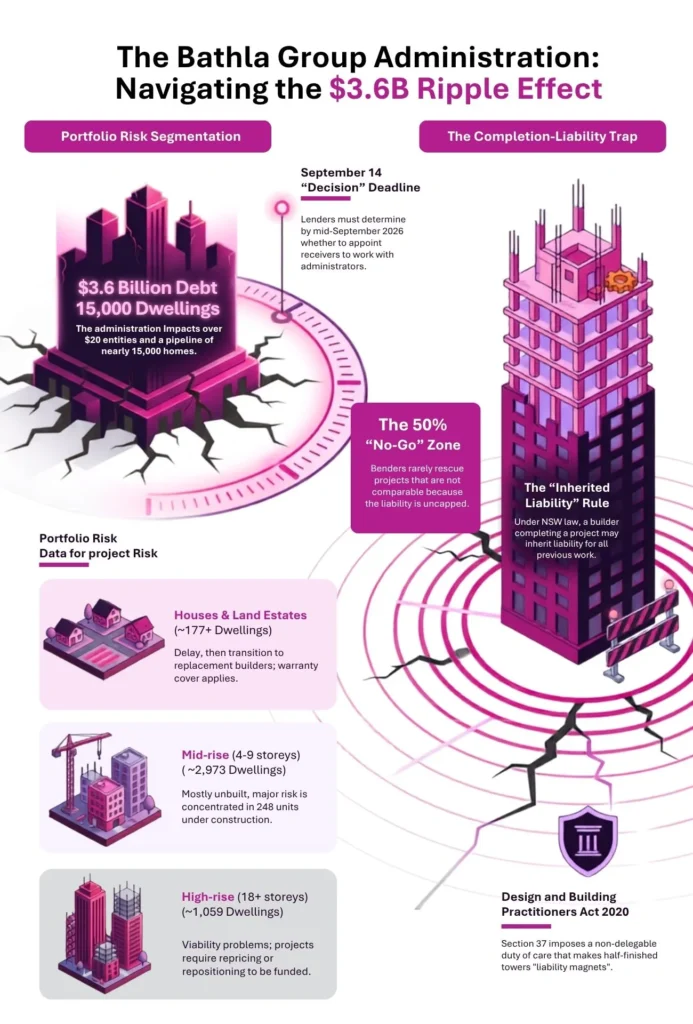
| Risk level | What it is | Named projects | Disclosed dwellings | Likely outcome |
|---|---|---|---|---|
| Low | Houses, townhouses, house and land, plus 33 land estates across 18 suburbs (not enumerated in the register) | 6 named, plus the estate footprint | ~177 named | Delay, then transition to a replacement builder. Under the three-storey threshold, so warranty cover applies. |
| Medium | Medium-density apartments, four to nine storeys | 17 | ~2,973 | Mostly unbuilt: discount and delay. The sharp end is 248 dwellings actually under construction. |
| High | Towers — 18 to 21 storeys, and the 926-apartment Mount Druitt proposal | 3 | ~1,059 | Not delivery problems but viability problems: repricing, restaging or repositioning. |
Low risk:
Medium risk:
Medium-density apartments, where the answer depends on how far it’s built. This is where the apartment count sits: Cabramatta (673), Croatia Avenue (600), The Entrance (414), Pelican Road (195), Box Hill at 6 Alan Street (178) and a dozen more of four to nine storeys. Almost none of it has been built. These are consents over land: no completion liability, no occupation certificate to obtain, no half-finished building for anyone to inherit. The risk is discount and delay, not impossibility.
The sharp end of that tier is small and specific. Three projects are apartment buildings actually under construction: Darkes Road at Kembla Grange (108 apartments, delayed, purchaser complaints reported this month), Ashford Rose at Castle Hill (68 apartments, the site described as dormant, completion now put at late 2028) and Jardin at Marsden Park (72 apartments, forecast for late 2026). Two hundred and forty-eight dwellings, against a pipeline quoted at fifteen thousand. Those two ends behave in opposite ways: Jardin is nearly finished, which makes it the hardest to hand over and the easiest to justify funding, because it is closest to producing settlement proceeds. Ashford Rose is stalled early against a date three years out cheap to abandon, expensive to wait on.
High risk:
Why the middle tier is the one to watch, and why the backdrop differs by state
Medium-density is where the regulatory gap bites. In New South Wales the Home Building Compensation scheme does not cover new multi-dwelling buildings with a rise in storeys of more than three. A Building Code calculation rather than a floor count, to check building by building. On the face of it, under-construction projects sit above that line. So there is no warranty cover for those buyers, and a replacement builder taking one on is exposed under section 37 of the Design and Building Practitioners Act 2020 to every subsequent owner, its non-delegable and cannot be apportioned down to the trades who did the work.
Except that land clears only when it is sold into an orderly market. It does not clear at book when thirty-three estates' worth of lots and a dozen approved sites are pushed out as receiver sales in the same quarter, in the same handful of corridors Blacktown, The Hills, Marsden Park, Schofields competing against each other. A package sold under a forced-sale banner sets a comparable, and that comparable then prices the collateral behind every other lender in this group, and the feasibility of every unrelated project in the same corridor. The individually rational decision to enforce and sell is, in aggregate, a supply shock in markets thin enough to feel it.
For a number of these lenders the better answer is therefore not to sell but to hold. Land bank the sites, meter the lot releases, and take the recovery over eighteen months rather than eighteen weeks. That is an unfamiliar position for a project financier, and a far easier one for a bank or a fund with duration than for private credit with a maturity to meet which is exactly why it needs working out now, lender by lender, rather than discovered after the first three receiver campaigns have reset the comparables.
Lender Action
What to do by tier
For buyers, what predicts an outcome is not which entity holds the contract. It is what was bought, how far along it is, and when it was signed. Low-rise, hold, expect delay, expect a new builder. Medium-density not yet started, then check the sunset date a vendor cannot rescind under section 66ZS of the Conveyancing Act without the purchaser's consent, a court order or a prescribed circumstance, and administrators inherit that constraint exactly. Medium-density under construction, this is real exposure, and the group most likely to be handed generic advice. Check whether the deposit is held in trust under section 66ZT, which covers only contracts from 1 December 2019, only residential lots, and nothing where a deposit bond was given.
For subcontractors, one correction already being got wrong. An adjudication under the Security of Payment Act is not a court proceeding, so the moratorium does not stop a payment claim or an adjudication against a company in administration. Section 32B bars companies in liquidation, not administration. What needs consent or leave is enforcing the certificate, adjudicating still fixes the amount.
A voluntary administration is not a verdict. “Bathla has collapsed” tells a family in a Marsden Park townhouse nothing useful, and most of what it implies to them is false. The register says most of this pipeline is land and low-rise housing that will be delayed and then delivered by somebody else; that the apartment stock is overwhelmingly unbuilt and will be repriced rather than abandoned; and that the number of buildings where people are waiting on a real half-finished structure is comparatively small. That is a solvable problem with a fortnight on the clock.
Figures are press estimates and approximate. Project status is summarised from public reporting, and the tiering is a judgment about outcome risk rather than a statement about the financial position of any entity. Scope should be confirmed against the ASIC notices.