
On 25 August 2026, KordaMentha was appointed to Edge Early Learning. Seventy centres. Forty-four companies, around 2,200 families alone waking up to a headline they never expected to read about their child’s centre.
It was not a demand event. It was a rent event.
Edge asked its largest landlord for relief on 31 July. The landlord said no. August rent went unpaid. Default notices followed on 4 August. Three weeks later the group was in voluntary administration, and its landlord’s securities were down 22 per cent in a session.
That sequence is the whole story of this sector in miniature, and it is why I keep having the same conversation with operators, lenders and landlords who each believe they are looking at an isolated problem.
They are not.
The paradox nobody wants to say out loud
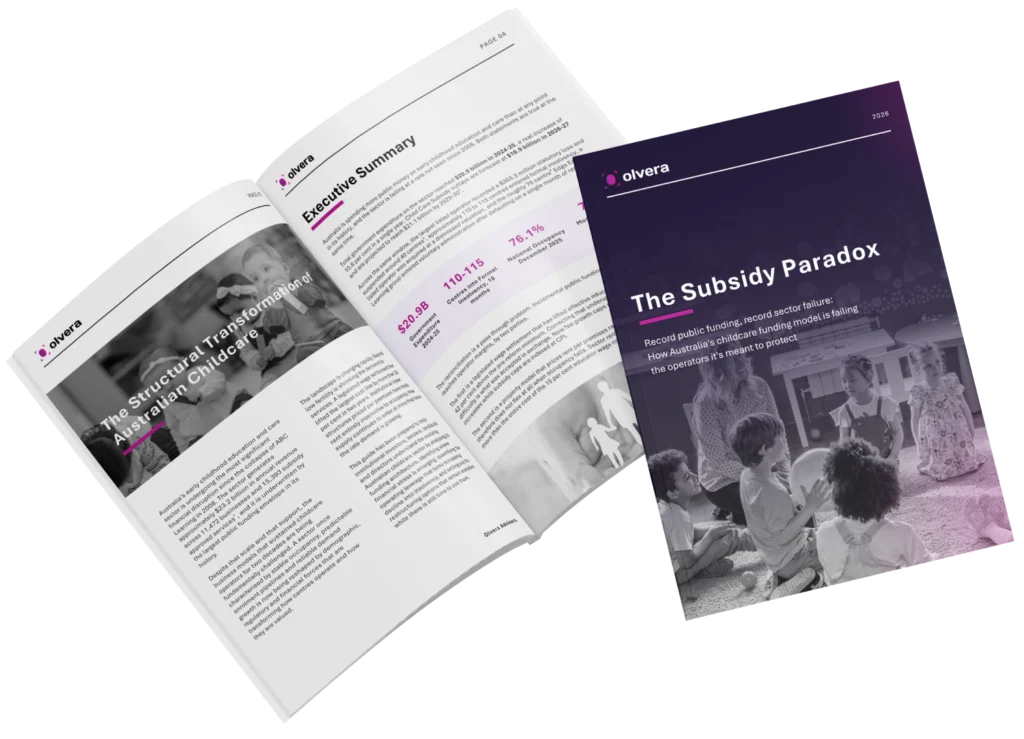
Australian governments spent $20.9 billion on early childhood education and care in 2024-25. That is a real increase of 10.6 per cent in a single year. The Child Care Subsidy alone is forecast at $16.9 billion for 2026-27, rising toward $21.1 billion by 2029-30.
Public funding for this sector has never been higher.
Over exactly the same window, the largest listed operator posted a $303.3 million statutory loss and suspended around 40 centres. Roughly 110 to 115 centres entered formal insolvency between February 2025 and August 2026. A listed operator was taken out at 50 cents a share. Four major private equity platforms cannot exit at any price they would accept.
Record money in. Record distress. At the same time. We have been doing this a long time this is not an economic climate issue, this is structural.
Follow the dollar and the crisis explains itself
Every incremental dollar of public funding entering this sector is being claimed before it reaches an operator’s margin. Two claimants get there first.
Wages, quite properly, get there first. The Worker Retention Payment funds a 15 per cent above award increase plus a minimum 20 per cent for on costs. Then the Fair Work Commission’s gender undervaluation decision permanently lifted Children’s Services Award rates by between 9.4 and 27.8 per cent, phasing from March 2026. Then the Annual Wage Review added 4.75 per cent from July 2026. Superannuation sits at 12 per cent.
Stack those and mid-level award rates rose somewhere in the order of 21 to 24 per cent between July 2024 and July 2026. Effective pay with pass through is roughly 39 to 42 per cent above the pre reform minimum.
Educators were underpaid and correcting that was overdue. That is not the problem.
The problem is what sits on the other side of the ledger. In exchange for the retention payment, operators accepted fee growth caps of 4.4 per cent, then 4.2 per cent, now 5.8 per cent. Subsidy caps index to CPI at about 3.8 per cent. Labour is roughly 69 per cent of centre-based day care costs and 77 per cent of outside school hours care costs.
So, the largest cost line in the business is rising at more than 20 per cent over two years, while the revenue line is legally constrained to single digits. There is no version of that arithmetic that ends well, and no amount of operational discipline that closes it.
Rent gets there second, and rent does not negotiate. This is the piece the market consistently underestimates. Institutional childcare leases are triple net, run 15 to 20 years with options out to 25 or 30, escalate at a fixed 3 to 4 per cent a year, and are priced per licensed place rather than per enrolled child. Rent is charged on the places you are allowed to fill, not the places you actually filled.
A healthy centre runs rent at around 8 per cent of revenue. A distressed centre runs at around 18 per cent. Nothing changed in the lease. Only occupancy changed. The sector’s total rent bill is estimated at $2.71 billion a year, which is more than the entire cost of the 15 per cent educator wage rise.
Occupancy is falling
Australia’s total fertility rate hit a record low of 1.481 in 2024. Births are down about 7 per cent from their 2018 peak. Families using subsidised care fell 1.7 per cent in the March 2026 quarter, with centre-based day care families down 2.5 per cent.
Meanwhile the sector added 277 net new centre-based services in a single year.
Around 30,000 new places are entering the market annually against demand growth of roughly 11,000. National occupancy has fallen from an estimated 81.8 per cent in December 2023 to 76.1 per cent in December 2025. Western Australia sits at 70.5 per cent. The largest listed operator reported spot occupancy of 56.4 per cent in April 2026.
A centre that looks comfortable at 88 per cent occupancy can be losing money at 68 per cent. With breakeven occupancy now sitting at or above the national average occupancy of 76.1%, a material share of this sector is trading below its own break even and financing the gap from working capital.
Roughly 24 per cent of Australians live in childcare deserts. Capacity is exiting through failure in thin outer suburban and regional markets while ten-million-dollar centres trade at compressed yields in wealthy metropolitan areas. Market exit is removing supply precisely where access was already worst.
If you are a landlord, a lender or an investor, this is now your problem
The transmission channel from operator distress to capital is no longer theoretical. It has been demonstrated.
One listed REIT held 31 Edge properties producing around 14 per cent of its annual property income, sat on approximately $4 million in pooled bank guarantees, delayed its results for an independent valuation review and guided to a 7 per cent distribution cut. Securities fell 22 per cent on disclosure.
Four million dollars of security against fourteen per cent of income. That is the number I would be re-underwriting across every childcare exposure in the country this quarter.
For lenders, the near-term event risk is refinancing. One major private equity owned platform carries $563 million of borrowings, around 85 per cent of it a syndicated facility maturing against a verified loss-making earnings base and a sale process stalled since 2023.
For sponsors, the exit maths is also simple. Going concern multiples of 3.0 to 4.5 times EBITDA for single centres, and 5 to 8 times for platforms, sit well below 2021 vintage entry prices. Guardian has been unsold since 2023. Affinity is stalled. Busy Bees never completed. Blocked exits do not stay neutral, they generate capex starvation and understaffing, which walks straight into a regulatory environment where penalties now reach $1,034,100 for large providers in New South Wales and cannot lawfully be insured.
Directors
If you sit on the board of an operator in this sector, three things are true right now.
Your revenue is capped by policy. Your largest cost is legislated upward. Your second largest cost is contractually fixed and indexed regardless of how many children walk through the door.
That is not a trading problem you manage quietly for another two quarters. Insolvent trading exposure is personal, and the recurring pattern in this window is not a slow decline. It is an operator negotiating a sale, the sale collapsing, and liquidity running out inside days. Two centres in this cycle closed with less than 24 hours’ notice to families.
Safe harbour exists for exactly this situation, but it only protects you if you enter it while you still have options. Engaged early, the toolkit is real: lease renegotiation and surrender, portfolio rationalisation before it becomes a fire sale, restructuring plans, informal creditor standstills, recapitalisation. Engaged late, you are choosing between administration and liquidation, and someone else is choosing for you.
Everything points to 30 June 2028
On that date the $3.6 billion Worker Retention Payment and its attached fee caps expire together. The Fair Work increases they were paying for are permanent and unfunded. From July 2027, funding is conditioned on meeting Quality Area 2 of the National Quality Standard, which will remove marginal services.
There are now two paths. Orderly consolidation, where a successor mechanism or genuine cost-based pricing is legislated before mid-2028 and capacity leaves gradually through lease expiries. Or disorderly failure through insolvency.
When ABC Learning collapsed in 2008, continuity was secured by $22 million of emergency funding and a bespoke philanthropic consortium buying 678 centres. That was improvisation, not policy. Eighteen years later we still have no statutory resolution regime for a sector where the Commonwealth funds around 70 per cent of centre revenue.
As one senator put it: if a school closed tomorrow, governments would have a plan. Here there is not!
What to do with this
Operators and boards. If your occupancy is under 75 per cent and your rent to revenue is above 12 per cent, you are already in the zone where directors’ duties are live. Get a confidential safe harbour and viability assessment done while you still hold the pen.
Landlords, lenders and investors. Ask us for a portfolio exposure briefing. We will stress test tenant covenants, security adequacy and recovery scenarios against the failure patterns this cycle has actually produced, not the ones your models assume.
I would rather have this conversation with you in September 2026 than in June 2028.
Olvera Reports
The Subsidy Paradox