
As we approach our sixth anniversary on 1 July, it’s a fitting moment to reflect not just on how far we’ve come, but to revisit something that has been central to our identity from day one: our name.
Olvera Advisors was never chosen by chance. It was deliberately selected to represent a way of thinking – one that continues to shape how we approach every engagement today. It is the idea captured in the words we still live by: turning uncertainty into your advantage.
A Name with Meaning
The inspiration comes from a conversation between our founding Principals, Damien Hodgkinson and Kate Barnet. Initially, there were ideas about naming the company after a laneway in Sydney, but they couldn’t land on any that worked. As Kate explains:
“I asked Damien what was his favourite city in the world, and he told me it was Los Angeles.” – Kate Barnet, Founding Principal
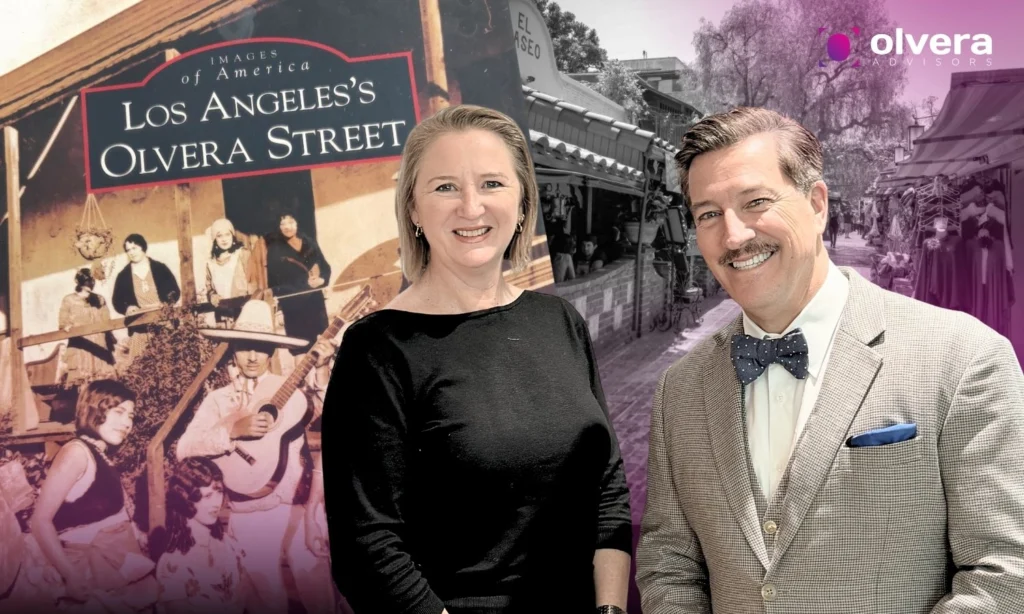
That led them to search for laneways in LA – and one really stood out: Olvera Street. The story behind that search became the foundation for the firm’s identity.
A Street That Refused to Fade
Olvera Street is widely regarded as one of the oldest parts of Los Angeles, the place where the city’s history began. The timeline tells its own story of decline and reinvention.
Los Angeles, 1781. El Pueblo de Nuestra Señora la Reina de los Ángeles is founded by 44 settlers from Mexico. The area around what is now Olvera Street becomes the civic, cultural and commercial hub of the city – the town square, surrounded by homes, government buildings and markets. In modern terms, it was the “CBD” of early Los Angeles.
Los Angeles, 1929. After roughly 150 years, the street is condemned, dilapidated and written off – neglected, overlooked and scheduled for demolition.
Los Angeles, 1930. Olvera Street reopens as a vibrant marketplace – restored, reimagined, alive. Today it remains LA’s oldest commercial district and a living monument to creative reinvention.
But what makes the story truly meaningful is not just its history – it’s the story of what nearly happened to it, and the one person who saw value in its transformation.
Who Was Christine Sterling?
Christine Sterling (1881–1963) was not a developer, planner or civic official. Born in San Francisco into a relatively well-off family, she later became part of Los Angeles’ social and cultural elite, moving in privileged networks far from the kind of urban decline she would come to confront.
When Sterling first walked down Olvera Street in 1926, she didn’t find a thriving cultural landmark. She found decaying buildings, abandoned infrastructure, social decline, reputational damage, and an area scheduled for demolition. But she also recognised the birthplace of the city, a direct link to its Spanish and Mexican heritage, and something significant that was being neglected.
To most observers, including city planners, Olvera Street was a liability. The logical course of action was simple: remove it and start again. Sterling saw something fundamentally different – history that could not be replaced, cultural significance that still mattered, and a foundation that, while deteriorated, remained intact.
“She looked at a row of dilapidated buildings and saw what they could become. She didn’t bulldoze the past – she partnered with it.” – On Christine Sterling, ’The Mother of Olvera Street’
Sterling leveraged her relationships with the Los Angeles Times to drive public support, connected with investors and civic leaders, gained backing from local government, and secured practical resources, including labour. She built a coalition of stakeholders, aligned them around a shared outcome, and drove momentum where there had been none.
Her revitalisation is, in many ways, an early example of what we now recognise as a turnaround. Where others saw decline and demolition, she recognised underlying value and acted early to preserve it. She worked with what remained, reframed its purpose, and restored confidence among stakeholders – ultimately transforming a distressed asset into something enduring.
That same mindset – reinvention over demolition – underpins the work we do at Olvera Advisors every day.
Born in the Storm, Built for the Rebuild
There is a reason the story of a street saved from demolition resonated so deeply with the firm Damien and Kate set out to build – because Olvera Advisors was itself born of a moment of profound transition.
The firm was established in 2020, as COVID-19 was redrawing the global economy. Our founding Principals saw what was coming, a higher cost of capital, repriced global assets, and entire industries that would not survive without a new way of thinking. Like Sterling surveying a condemned street, they looked at a moment of upheaval and saw not just risk, but the chance to build something better.
Their answer was a different kind of restructuring practice – one closer to the founders, the families and the entrepreneurs running the businesses, working in partnership rather than from behind a desk.
“We started Olvera because our clients needed a perspective, not just a process.” – The Founding Principals, 2020
Diversity, too, was central from the outset. As Kate puts it:
“Diversity was a concept that was central to our ethos and the fundamental basis for which we decided to do what we did. We wanted to create a place that embraced diversity in mind, spirit and being. We truly believed fostering diversity would create better outcomes for clients.” – Kate Barnet, Founding Principal
That is how we arrived at the name Olvera Advisors – a firm built, from its first day, for reinvention rather than demolition.
The Philosophy Behind the Name
At Olvera Advisors, we are often brought into situations where businesses are under pressure – where performance has deteriorated, uncertainty is high, and outcomes are not yet clear. In those moments, it is easy to focus on what is visible: financial stress, operational challenges, or stakeholder tension.
As Damien highlights, like Olvera Street, the real value of a business is often less obvious.
“Our role is to uncover the real value – to understand the underlying strengths, the operational reality, and the opportunities that still exist, and to create a structured path forward.” – Damien Hodgkinson, Founding Principal
Six Years On
Over the past six years, we’ve worked alongside boards, lenders and stakeholders across a wide range of complex situations, while we have also grown from two partners to seven with a growing team of deep specialists across industries from finance to retail. What has remained consistent is our approach:
- Looking beyond the immediate challenges
- Bringing clarity and structure to uncertainty
- Focusing on outcomes that preserve and realise value
The philosophy embedded in our name has guided that approach from the beginning.
More Than a Name
Olvera represents more than a place. It reflects how we think, and it is why heritage sits at the foundation of who we are:
- History matters – every business has a story worth understanding.
- Value is not always visible – experience and perspective uncover it.
- Preservation and transformation go hand in hand – the best outcomes build on existing foundations, evolving without losing what made a business itself.
- One person can start a movement – Sterling started alone; the right perspective, backed by the right team, can change an outcome.
Looking Forward
As we mark our sixth anniversary, Olvera Street remains a powerful symbol of what can be achieved with the right perspective and intent. It’s a reminder that even in periods of decline – or in the middle of a storm – there is often something worth preserving and rebuilding.
Heritage, values, people and future – that belief continues to underpin everything we do. And it’s why, six years on, we remain proud to be called Olvera Advisors.

