
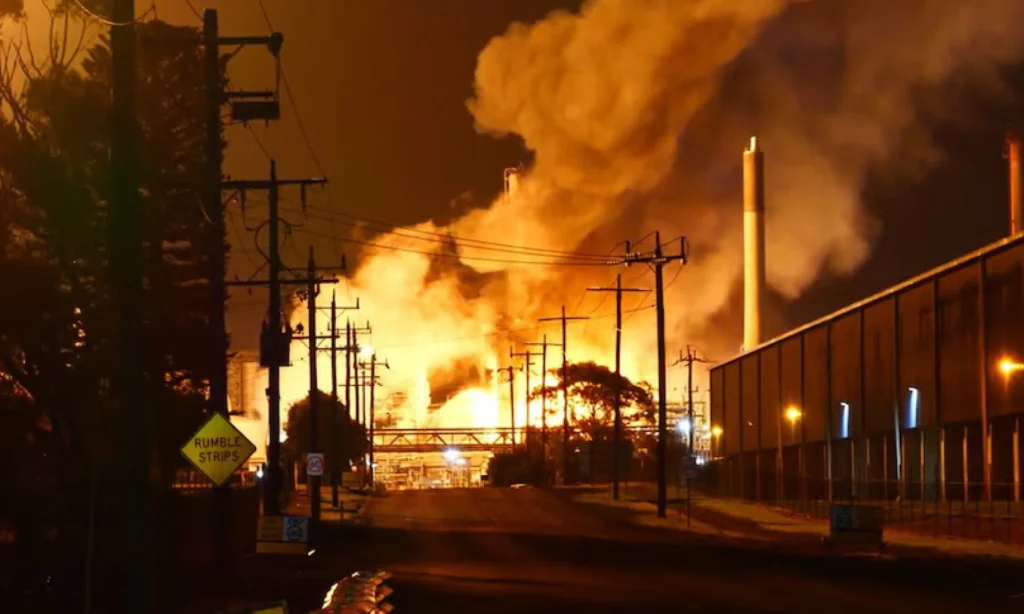
As the world grapples with the sharpest fuel disruption in half a century, Australia has been dealt another blow. Last week, a major fire broke out at Viva Energy’s Geelong oil refinery - one of just two operational oil refineries remaining in the country. Authorities declared a Watch and Act alert for much of the Geelong region, urging residents to stay indoors due to hazardous smoke, while Fire Rescue Victoria confirmed that the blaze was “not yet under control” as of Thursday morning.
This incident could not have come at a worse time. With the Strait of Hormuz effectively closed amid the Iran war and choking off roughly 20% of the world’s oil supply, global petrol and diesel prices were already surging to two-year highs before the Geelong outage. Australia, which imports about 90% of its refined fuel needs, is now facing a deeper structural vulnerability.
A Fragile Refining Backbone
The Geelong facility, operated by Viva Energy, supplies roughly 10% of Australia’s petrol, diesel, and jet fuel. Together with Ampol’s Lytton refinery in Brisbane, it forms the nation’s last line of defence against total dependence on overseas fuel supplies. Both plants were already operating under significant financial strain, sustained partly through a government subsidy program set to expire next year.
If the damage at Geelong leads to extended downtime, local refining capacity could fall by half, pushing Australia to rely almost entirely on imported petrol at a time when global supply chains remain fractured.
That scenario could have multi-layered consequences across the economy.
Immediate Economic Ripple Effects
Fuel is a fundamental input across every sector. Rising prices feed straight into inflation through higher transport and logistics costs, while reduced availability strains supply chains. Treasury warnings in March suggested that deeper oil shocks could add a full percentage point to inflation.
For Australian businesses already navigating the post-pandemic cost environment, this additional pressure will accelerate the cash flow squeeze, particularly in industries dependent on movement, energy, and imports.
Implications for the Industrial and Manufacturing Sectors
Australia’s industrial base (spanning manufacturing, transport, logistics, and heavy industry) is especially sensitive to energy disruptions. The impact is likely to unfold for various reasons, some of them being:
- Fuel Supply Constraints: The Geelong refinery contributes roughly 10% of the nation’s refined fuel. Any extended outage risks driving up diesel and aviation fuel prices, directly affecting distribution networks, machinery operation, and raw material movement.
- Production Cost Pressures: Manufacturing operations that rely on steady energy inputs may face deferred production schedules or margin compression as input costs increase. For exporters, this adds another layer of uncompetitiveness at a time when global demand is softening.
- Supply Chain Vulnerability: The ripple effects through logistics networks could create delays and cost pass-throughs across all sectors. Businesses dependent on just-in-time inventory systems (from construction materials to packaged goods) are particularly exposed.
- Restructuring and Liquidity Risks: Companies already under strain from slower demand and constrained credit will find rising energy costs eroding remaining buffers. This increases the probability of distress events across mid-tier industrial operators, especially those with high working capital requirements or leveraged balance sheets.
Mining
Transport and Logistics
Strategic Challenges and Forward Steps
For Australian businesses, particularly in industrial and transport-related sectors, the path forward requires deliberate financial and operational preparedness. Leadership teams should take immediate steps to:
- Reassess cost structures and revisit pricing strategies to factor in higher energy volatility.
- Stress-test liquidity and debt covenants under multiple fuel price and supply scenarios.
- Strengthen supplier relationships and consider diversifying procurement channels where possible.
- Identify early restructuring levers, from asset optimisation to refinancing, to preserve operational viability in the event of prolonged cost escalation.
For many firms, these steps are not signs of distress but measures of resilience, which is essential for navigating a convergence of global and domestic headwinds.
A Critical Moment for National Energy Resilience
The Geelong refinery fire exposes a deeper structural vulnerability in Australia’s supply chain and one that extends beyond the energy market itself. With limited refining capacity, minimal fuel reserves, and growing dependence on global supply lines, the country’s industrial economy remains one major event away from systemic disruption.
Strengthening national energy security will require coordinated policy, investment incentives, and a clearer alignment between government, producers, and industrial consumers. Until then, businesses must focus on agility and financial discipline as primary tools of survival.