
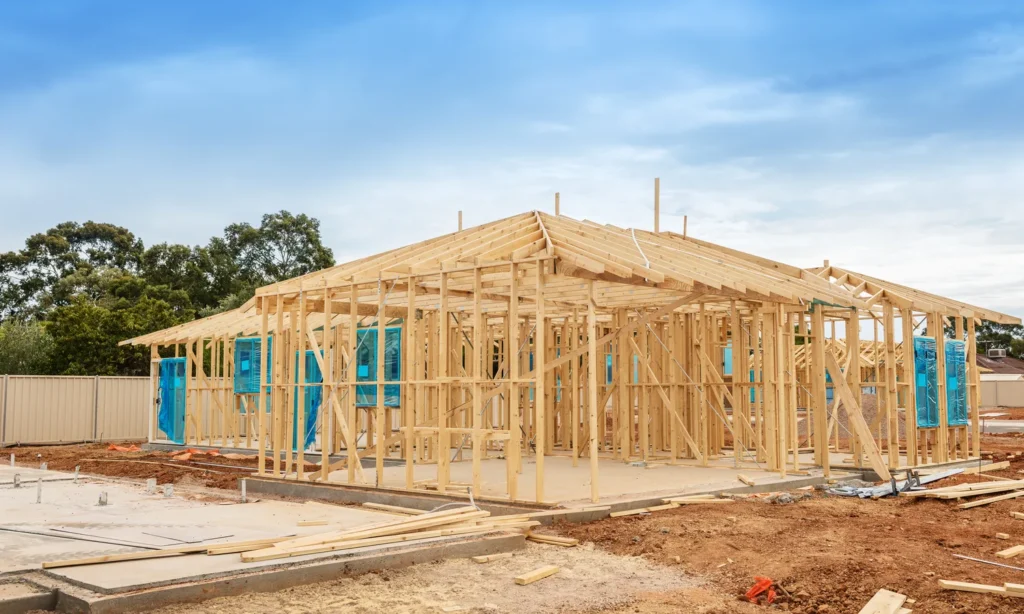
Why the Christmas close-down is the riskiest time of year for construction, and what to do if your builder can't finish the job
Every December the same thing happens. The tools go down, the site fence gets locked, everyone heads off for the holidays, and some builders never come back.
This isn't bad luck. The Christmas close-down puts more pressure on a construction company's cashflow than any other point in the year, and the insolvency figures show it.
What the numbers say
- 3,472 construction companies entered external administration or had a controller appointed for the first time in 2025-26 (ASIC).
- 24.5% of all company insolvencies in Australia were construction businesses, out of 14,152 nationally. It remains the most insolvent industry in the country.
- The December quarter was the worst of the year. Across all industries, the December quarter was the worst of the year, with 3,856 companies entering insolvency.
- Lenders are acting first. Receiver appointments in construction rose 71% in 2025-26, while voluntary administrations fell 23%. Financiers are taking control rather than waiting for directors to act.
- Creditors rarely get their money back. ASIC's latest review found only 5.3% of finalised liquidations paid any dividend to ordinary unsecured creditors, with a median return of 9.8 cents in the dollar.
- Late payment is built into the industry. Around 11.6% of small construction businesses are carrying payments more than 60 days overdue at any one time, and nearly a third of construction collapses are linked to payment delays.
- Subbies are pricing in the risk. In a 2026 survey of 754 subcontractors, 57% said they had raised their rates or added a risk margin because of slow or unreliable payment.
- Margins have been squeezed. Building costs have risen about 30% in five years, leaving builders on older fixed-price contracts with little room to absorb a cash shortfall.
The five-year trend shows how far the industry has climbed. The small fall in 2025-26 is the first in five years, but the number is still almost triple what it was in 2021-22.
Construction companies entering external administration or controller appointment for the first time (ASIC Series 1)
| Financial year | Construction companies | Change on prior year |
|---|---|---|
| 2021-22 | 1,284 | — |
| 2022-23 | 2,213 | +72% |
| 2023-24 | 2,977 | +35% |
| 2024-25 | 3,596 | +21% |
| 2025-26 | 3,472 | −3% |
Why Christmas breaks builders
The close-down opens a cashflow gap that a lot of builders can't bridge:
- No work means no progress claims. Three to four weeks without completed stages means very little money coming in.
- The costs keep running. Wages, holiday pay, leave loading, super, tax, equipment finance, rent and insurance don't stop over the break.
- Everyone wants paying before Christmas. Subcontractors and suppliers chase their invoices hard in December, so cash goes out at the moment it's tightest.
- Funders slow down. Bank and private lender approvals, valuations and drawdowns stall over the holidays, so builders can't refinance their way out of trouble.
- Decisions get made over the break. Many directors decide in January that they can't reopen. Owners, developers and trades often find out when nobody turns up on site.
The damage spreads well beyond the builder. A Senate inquiry estimated the industry carries around $3 billion a year in unpaid debts, much of it owed to subcontractors who then struggle to pay their own staff and suppliers.
A well-developed programme is your first line of defence
Most builders who fail over Christmas don't fail because of one bad week. They fail because the programme and the cashflow were never planned together. A programme that simply shows the site closing on 19 December and reopening on 12 January hides the real problem, that is four weeks of costs with no claims coming in.
A properly developed programme for the Christmas period should do five things:
- Bring claimable milestones forward. Sequence work so that a meaningful stage, such as frame, lock-up or fix-out, is reached and certified before the shutdown. A progress claim lodged in early December can be paid before the break. One lodged on 20 December often isn't paid until late January.
- Line the cashflow forecast up with the programme. Map every progress claim, wage run, holiday pay, super payment, BAS and supplier account against the dates in the programme. The lowest point in the forecast almost always lands in the first three weeks of January.
- Lock in materials and trades for the restart. Suppliers and subcontractors book up quickly in January. Confirming orders and start dates before the break avoids a slow restart that stretches the cash gap even further.
- Track float and the critical path. If the project has no float left going into December, any January slip goes straight to the completion date, and with it the developer's holding costs and the homeowner's rent.
- Be shared openly. The owner, financier and builder should all be working from the same programme and cashflow forecast. Surprises in January are what turn a tight month into a collapse.
For owners and developers, the programme is also an early warning system. If the builder can't produce a credible programme and cashflow forecast through to February, treat that as a warning sign in its own right.
Warning signs to watch for now
- Requests for payment early, or out of step with the contract
- Subcontractors leaving site or complaining about late payment
- Materials not arriving, or suppliers asking for cash on delivery
- The builder going quiet or giving vague answers about the January restart
- No updated programme, or a programme that keeps slipping without explanation
- Pressure to approve variations or price increases on a fixed-price contract
Why leaning in usually costs less than starting again
When a builder asks for help, the instinct is to hold firm on the contract price. On paper that protects you. In practice, if the builder fails, the contract price stops mattering, because you will be paying a new builder whatever the market charges to finish someone else's job.
Finishing a part-built project is rarely cheap. Completion builders take on work they didn't do and can't fully see, so they price in that risk. Builders under financial stress often cut corners before they collapse, which means hidden defects are common, and trades generally charge more to fix existing work than to build new. Lawyers acting for homeowners say replacement quotes regularly come in well above the unpaid balance of the original contract.
The costs of a restart add up quickly:
- Delay. Notifying the insurer, terminating the contract properly, getting a defects report, retendering and remobilising can take months before work starts again. One WA family waited around 22 months between signing their contract and a slab being poured after their builder fell over.
- Holding costs. Interest, land tax, rates and, for homeowners, rent or a second mortgage keep running every month the site sits idle.
- A higher completion price. A new builder prices today's labour and materials, plus a premium for inheriting another builder's work.
- Rectification. Defects and missing work have to be found and fixed before the new builder will warrant anything.
- Paying twice. Subcontractors and suppliers who weren't paid by the failed builder may stop work, remove materials or need paying again to come back.
- Warranty cover is capped. In NSW the cap is $340,000, and in Victoria claims for incomplete work are limited to 20% of the contract price. In WA, the average indemnity claim has climbed above $41,000.
An illustrative comparison
Take a $1.2 million residential project that is 60% complete going into December. The builder has a $90,000 cash shortfall caused by a delayed claim and rising costs, and asks the developer for help.
| Cost item | Lean in and finish | Builder fails, restart |
|---|---|---|
| Extra funding or price increase | $90,000 | Nil |
| Delay before work restarts | 2 to 3 weeks | 4 to 6 months |
| Holding costs at $12,000 a month | $7,000 | $48,000 to $72,000 |
| Completion premium on remaining $480,000 (15% to 30%) | Nil | $72,000 to $144,000 |
| Defects report, legal and retendering | Nil | $25,000 to $50,000 |
| Indicative total extra cost | About $97,000 | $145,000 to $266,000 |
Even if the developer never recovers the $90,000, it is a fraction of the cost of a restart. The bigger saving is time. Every month a project sits idle costs money that can never be won back.
How to lean in without taking on the builder's risk
Supporting a builder is not the same as writing a blank cheque. The aim is to bridge a genuine cash gap while protecting your position. Options include:
- Paying early for certified work. Bring forward a progress payment for work that has been inspected and certified, rather than paying for work not yet done.
- Paying subcontractors and suppliers directly. With the builder's written agreement and proper documentation, pay key trades and suppliers directly so the money reaches your project and keeps the site moving.
- Paying for materials on site. Pay for delivered materials in exchange for clear title, registered on the PPSR where appropriate.
- Agreeing a price adjustment in exchange for security. If a higher price is the only way the job gets finished, document it in a deed of variation that gives you something back: step-in rights, a director's guarantee, a revised programme with firm milestones and visibility of the builder's project accounts.
- Using a project or trust account. Ring-fence progress payments so they can only be spent on your project, not used to plug holes elsewhere in the builder's business.
Before you commit, check that you are dealing with a short-term cash gap and not a business that is already insolvent. A builder with one stretched month and a sound order book is worth backing. A builder with debts across many projects may simply absorb your money and fail anyway. That's where an independent financial review earns its keep, together with legal advice on how any support is structured.
Act before the site goes quiet
The Christmas close-down doesn't cause construction failures, it exposes them. If your project, your payments or your business depend on a builder making it through to the new year, now is the time to check the programme, test the cashflow and decide whether to back your builder.
In most cases, a well-structured helping hand in December costs far less than a stalled site in February.
Olvera Advisors works with builders, developers, financiers and creditors to stabilise projects, protect cashflow and find a way forward when things go wrong. If you're concerned about your builder, or your own business, heading into the break, talk to us before the tools go down.
Sources
- ASIC Insolvency Statistics, Series 1 (data to August 2026) and ASIC media release 26-258MR, insolvent liquidation review (2026)
- Accountants Daily, Company insolvencies climb to 14,152 for FY2025–26 (July 2026)
- Master Builders NSW, What's happening with insolvencies in the construction industry (2026)
- The Good Builder, construction insolvency and payment analysis (2026)
- Payapps subcontractor payment survey (April 2026)
- Senate Economics References Committee, Insolvency in the Australian construction industry (2015)
- icare NSW and NSW Government, Home Building Compensation Fund guidance
- Business News (WA), Recovering the work of fallen builders; SBS News, The builder behind your dream home collapses
- Swaab, The risk of builder insolvency midway through a construction project (2025)