
A record year, and a Treasurer who noticed
Visitor spending in NSW rose $4.6 billion to a record $60.4 billion in the twelve months to December 2025. The State pulled 127.4 million international and domestic visitors, 224.2 million visitor nights, and $15.0 billion in international visitor expenditure, all record highs on multiple measures. NSW remains, comfortably, the country’s number one destination for visitors, nights and spend.
Demand has not just recovered; it has set records. The question this budget answers is what the government is prepared to spend to protect and extend a $60 billion engine, and deliberately it looks like not very much.
A $60.4 billion visitor economy at record highs. The government’s job in this budget wasn’t to create demand; it was to avoid getting in its way.
Funding the vibe
The visible spend is squarely aimed at vibrancy, not bricks. The Office of the 24-Hour Economy Commissioner gets $25.0 million to keep pushing the night-time economy, including into Western Sydney. The contemporary music sector (the live-music ecosystem that has been hollowed out by venue closures and rising costs) draws $29.3 million. A $26.8 million Creative Communities Policy targets Western Sydney and regional arts, and the State Library’s rooftop and bar finally open to the public via a $22.5 million redevelopment.
These are millions, not billions, a rounding error against a $60 billion visitor economy and a $116.7 billion infrastructure programme. But this is about sector signalling more than subsidies. A serious, funded 24-Hour Economy Commissioner with the political cover to ease trading rules, special entertainment precincts and red tape is worth more to a late-night venue than a grant. The dollars are small; the policy intent, is clear a Sydney that is allowed to stay open, is the asset.
The gaming story is enforcement, not reform
Here is where the budget gets interesting. Gambling and betting taxes were revised up by $86.5 million in 2025-26 and by $638.2 million over the four years to 2029-30. But if you look at the detail there is a warning for operators. The budget is explicit that the uplift includes additional compliance activity, and it books a specific revenue measure for “additional assurance activities on wagering and gaming operators”.
The government is growing its gaming take by tightening enforcement on operators, not by raising headline rates or pushing through the structural reform (cashless play, mandatory harm-minimisation) that the sector has been bracing for. There is no new tax shock in this budget. But there is a clear, funded signal that auditors and regulators are coming, and that compliance is now a permanent line in the operating model.
No new gaming tax. But a budget that grows the take through assurance and compliance is telling operators exactly where the pressure will land next.
Casinos soft, clubs protected, wagering the growth engine
Under the hood, the composition tells the strategic story. Casino tax revenue is soft, well down from prior peaks and only gradually recovering, a reminder that the troubled end of the gaming market is still a fiscal drag, not a growth driver. The genuine engine is the point-of-consumption tax on online wagering, growing at roughly 4.5 per cent a year toward $356 million. The structural shift of gambling from the venue floor to the phone.
Meanwhile, registered clubs keep their long-standing concession, gaming machines in clubs are taxed at materially lower rates than in hotels, a tax expenditure worth somewhere between roughly $1.04 billion and $1.16 billion a year. In a budget hunting for every dollar, leaving that concession untouched is a political choice. For investors weighing pub versus club versus online exposure, that differential is not trivia; it is the economics.
Major events, precincts and the experience economy
Beyond gaming, the budget keeps backing the reasons people actually travel and spend. There is $17.0 million to plan the redevelopment of the WIN Sports and Entertainment Precinct in Wollongong, continued support for State Sporting Organisations through $7.0 million, and free general admission locked in across the major cultural institutions: the Australian Museum, Museums of History NSW, the Art Gallery of NSW and the Powerhouse. Each of these is a footfall generator, a reason to book a hotel, fill a restaurant, sell a ticket and extend a stay.
This is the part of the strategy hospitality operators should read most closely. The government is investing in the events, venues and cultural anchors that drive visitation, then relying on the private sector (hotels, bars, restaurants, tour operators) to monetise the visitors those anchors attract. The public dollar buys the reason to come; the private operator captures the spend. That is a workable model, but only for operators positioned around the precincts, calendars and corridors the State is actually funding.
What the budget doesn’t fix
This is not a budget that addresses the cost crisis squeezing the floor. Insurance, energy, wages and food costs have done more damage to venue margins over the past two years than any tax line, and there is no broad relief package here aimed squarely at hospitality operating costs. The household sweeteners (cheaper registration, energy-bill help) are pitched at consumers, not at the businesses serving them. Operators hoping the budget would ease their P&L will be disappointed. The help is on the demand side, in keeping visitors coming and wallets open, not on the cost side.
Regional operators get a narrower deal again. There is targeted money (a $6.0 million package for tourism businesses around the Great Koala National Park, plus regional arts and music funding and the Wollongong precinct) but the heavy visitor spend still concentrates in Sydney and its events calendar. If your business sits outside the metropolitan and major-event gravity wells, you are competing for a thinner slice of public support, and your growth case has to rest on product and distribution, not on the budget.
Our assessment
This is a confident budget for hospitality and a watchful one for gaming. Demand is at record highs, the government is funding vibrancy and major-event infrastructure to keep it that way, and it has resisted a new gaming tax that would have hit margins directly. That is about as good as a constrained, deficit-year budget was ever going to be for the sector.
The direction is unambiguous. Gaming revenue is being squeezed out through compliance and assurance, not rate rises, so the smart operators should be investing in governance, monitoring and harm-minimisation now, ahead of the reform that this budget defers rather than cancels. Wagering is migrating online and being taxed accordingly. And the clubs’ concession survives another year, sharpening the gap between club, pub and digital models.
Our view the gaming floor is no longer a stable annuity, but one that will be a regulated that rewards compliance and scale. Then position around the experience economy, the events, precincts and night-time districts the State is spending real political capital to protect. The visitor economy is at $60.4 billion and climbing. This budget just told you which doors the government is holding open.
Olvera Reports
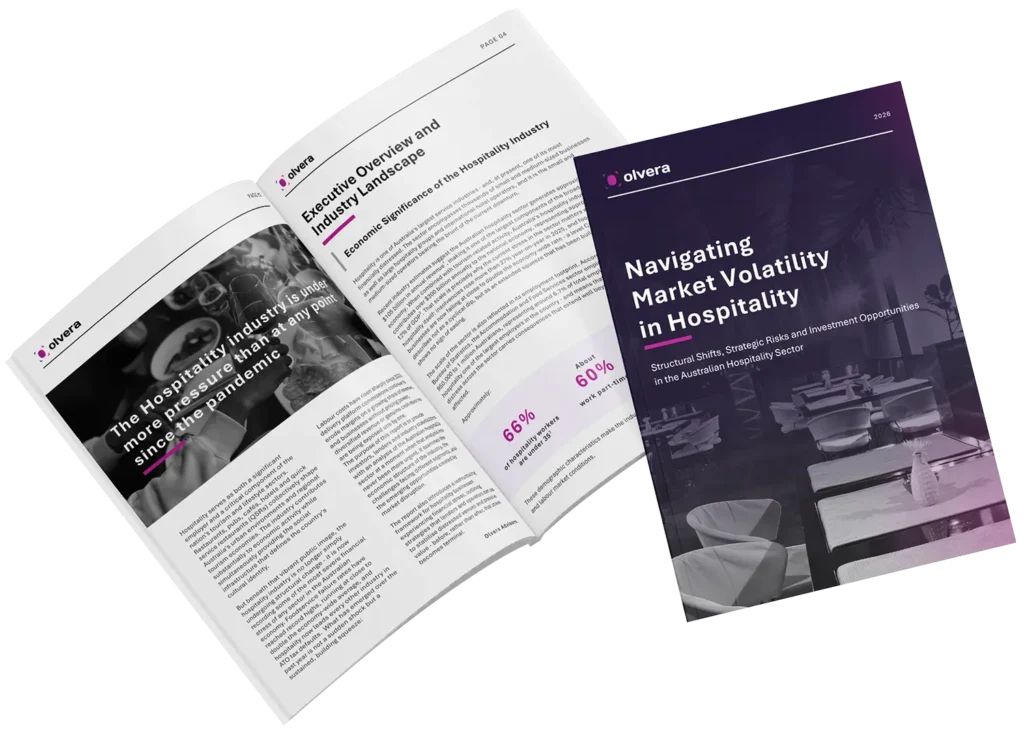
Navigating Market Volatility in Hospitality