There's a number that governs every concrete pour in Sydney, and almost no one outside the industry has heard of it. Ninety minutes. That's roughly how long ready-mixed concrete stays alive in the back of a truck before the chemistry turns against you. The moment water hits cement at the plant, the clock starts - and it doesn't stop for traffic, tolls, or planning announcements.
On 3 March 2026, the NSW Government started that clock on the future of inner-Sydney construction. The announcement was sold as housing up to 8,500 new homes at Bays West, a new harbourside suburb on government land at Glebe Island and White Bay, wrapped around a future metro station. The city needs the homes. But the same announcement confirmed that bulk port operations at Glebe Island - including the cement and aggregate handling that feeds the city's concrete - will cease by no later than 2030, with that freight pushed south to Port Kembla.
To build thousands of homes on one harbour island, the state is removing one of the few facilities that makes it physically possible to pour concrete quickly in the CBD and the eastern suburbs.
Concrete isn't a product. It's a deadline.
Most building materials are patient. Steel waits in a yard for a year. Timber, brick and glass sit in gridlock and arrive unchanged. Concrete is the exception, and the exception is absolute.
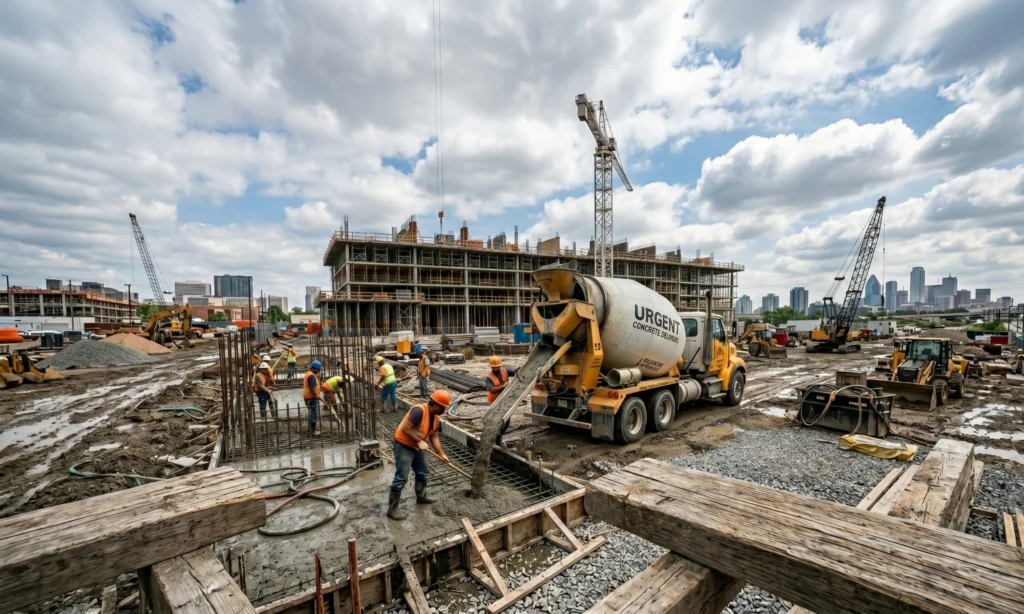
The instant water meets cement, hydration begins - it can't be paused or reversed. Ordinary cement starts to set in around half an hour. The drum on the truck buys time by keeping the mix turning, but the longer a load spins, the more it stiffens, the more water crews are tempted to add (quietly wrecking the strength), and the closer you get to dumping it.
That's why the industry has lived by the "90-minute rule" for nearly a century. Concrete should be discharged within 90 minutes of batching. Cool weather and the right admixtures stretch it toward two hours. Hot Sydney days don't. And on the work that matters most - major government infrastructure - the window is tighter still: Transport for NSW specifications can require concrete delivered and placed within 45 minutes of batching. From plant, through traffic, to the pour.
The geography of where you make concrete isn't a preference. It's a constraint baked into the material.
The maths of moving the plant to Wollongong
Glebe Island sits two to four kilometres from the CBD. A loaded truck reaches a city or inner-eastern site inside the window with room to spare. The site also has deep-water wharves, so raw materials arrive by ship, not road - a single shipload of cement takes thousands of truck movements off Sydney's streets.
Now the replacement. Port Kembla is about 85 to 90 kilometres south. In ideal conditions - empty roads, a light vehicle - that drive is around an hour and a quarter. A loaded agitator is not a light vehicle, the M1 is not empty, and Sydney's peak hour is not a rumour.
Do the arithmetic. A load batched at Port Kembla can burn its entire 90-minute working life before it even crosses into the city - and it blew past any 45-minute infrastructure spec somewhere near Helensburgh. Add the harbour crossing, the crawl east and the wait to get onto a constrained site, and the load is dead on arrival. You can't admixture your way out of a 90-kilometre freeway run.
A wharf for the ships, nothing for the trucks
Here's the distinction the announcement quietly blurs.
There are two separate things at Glebe Island. One is the import wharf - where ships unload bulk cement and aggregate. The other is the batching plant - where water meets cement and the 90-minute clock starts. They have completely different geographic needs.
The import wharf can move. Port Kembla is a deep-water port already built for bulk materials, and the $270 million earmarked for its road and rail links is a genuine plan for relocating that freight.
The batching plant is the problem. It has to be close to the pour - that's the entire point of it. And nothing in the announcement replaces Glebe Island's role as a near-CBD batching point with deep-water feed. The government has named a destination for the cement ships. It has named no destination for the concrete trucks. "Work closely with industry to ensure continuity of supply" is the only commitment on the table - an intention, not an address.
So what fills the gap? Most likely, inner-city pours get pushed onto existing metropolitan plants further out - plants fed by road, not ship. That lengthens every haul into the city and puts truck traffic back on the very roads the wharf was built to take it off.
And this is the second time we've played this game. The Glebe Island plant was itself the replacement for the Blackwattle Bay plant, displaced a decade ago for the new Sydney Fish Market. In ten years we'll have shunted concrete supply from Blackwattle Bay to Glebe Island to Wollongong - each move reasonable on its own, the sum a city exporting its own ability to build.
What it means on site
For builders in the CBD, Pyrmont and the eastern suburbs means fewer suppliers close enough to compete, so higher prices. Tighter, less reliable delivery windows. More rejected loads and pour delays, each one cascading through a program. Large continuous pours becoming genuinely hard to schedule when every truck is a multi-hour round trip. And the quiet quality risk of crews chasing workability on concrete that's been in the drum too long. The more water the more admixture and the less strength the concrete retains.
None of this stops the city being built. All of it makes building slower, dearer and riskier - exactly when the state is asking the industry to deliver more than ever.
Build the homes. Don't break the city that builds them.
Sydney needs Bays West. The honest position isn't "don't build." It's that you can't remove a deep-water, inner-city batching facility and replace it with a press release. If Glebe Island's supply role is ending, the state owes a concrete answer to a concrete question. Where, specifically, does fast, ship-fed, inner-city concrete come from after 2030?
Until that answer exists, Bays West is a bet that you can keep pouring a city while moving the place that makes the concrete 90 kilometres down the coast. The material already told us how that bet ends. It has ninety minutes. It doesn't wait.