
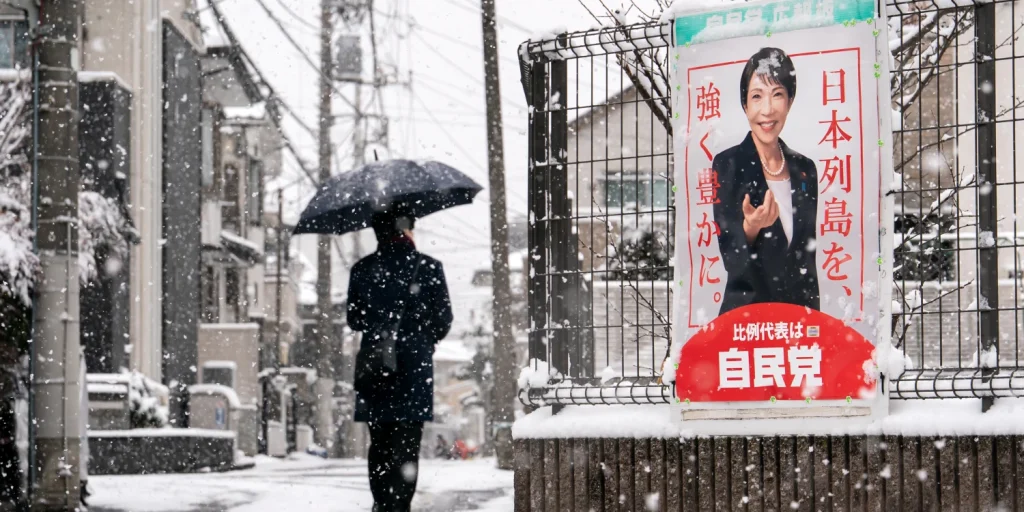
On Sunday 8 February, Japan held their Federal Election. Sanae Takaichi’s Liberal Democratic Party (LDP) won a landslide victory in the lower house (House of Representatives), securing a supermajority of seats – well over the 233 needed for a majority, with preliminary counts showing at least 316 seats on its own and around 352 seats in coalition with the Japan Innovation Party (JIP). This is one of the largest lower-house majorities in post-war Japanese history.
The LDP won with a mandate to cut sales taxes on food, increase government spending and stimulate the economy through government spending. This will be funded by new Japanese Government Bonds and higher yields. The last time this happened was in the 1990’s.
In 1992 this led to Australia’s recession which Paul Keating famously labelled “the recession we had to have.” It was a blunt diagnosis for a blunt economic reality: excessive leverage, high real interest rates, and a financial system that needed to be broken to be rebuilt.
After the weekend election the question being quietly asked in markets: are we heading back there again? The short answer is no. Australia is very different beast to what it was in 1992 but there are similarities.
Japan’s election delivered a decisive mandate for a government comfortable with fiscal expansion, tax relief, and strategic spending. Markets read this not as political instability, but as permission – permission for higher bond issuance and a higher long-run cost of capital.
The immediate result has been pressure on long-dated Japanese government bonds, particularly the 20–40-year sector. That matters because Japan is not just another bond market, it is the marginal price setter for global duration.
When Japanese yields rise:
- Japanese insurers and pension funds buy fewer US Treasuries
- Global long-term yields lift
- Countries like Australia import tighter financial conditions, even if their central banks do nothing
- To buy Japanese Bonds, Japan sells USD securities and the USD falls.
Why this is not 1992
The early-1990s recession was a cash-flow and solvency crisis. Households and corporates were over-levered, interest rates were high in real terms, and when the credit cycle turned, balance sheets collapsed.
Today’s Australia is structurally different in three critical ways.
Household wealth is vastly larger
Superannuation – introduced in 1992 – has transformed household balance sheets. Australians now hold significant financial assets alongside property. That does not make the economy immune to shocks, but it changes how they move through the market.
Property is a stabiliser
Housing wealth has supported consumption for decades. But it also means changes in long-term interest rates affect behaviour before unemployment rises. Australia’s hold vast wealth in geared investment properties. The first signal is not job losses, it is turnover, refinancing anxiety, and discretionary spending pull-backs.
The stress arrives through market rate changes
In 1992, banks broke, first the building societies then the State Banks. Today, the markets will move first. Equities, REITs, private credit, development finance will reprice well before traditional economic data moves.
So what could a slowdown look like?
If Japan’s bond repricing persists, Australia’s next six to twelve months may look more like this:
- Volatility in long-dated interest rates
- Pressure on rate-sensitive assets (property, infrastructure, private credit)
- Rising funding costs without an RBA cash-rate hike
- Selective, not system-wide, distress – especially in construction, development and highly leveraged SMEs
This is not a “recession we had to have”, it will be a repricing we need to navigate. The danger is not 1992-style mass unemployment, it is in the repricing of asset values, interest rate spreads and credit decisions.
Final thought: Japan’s election won’t cause Australia’s next slowdown, but it will test balance sheets. Those who remember 1992 will recognise the same warning signs. The economy always adjusts. The question is who adjusts first.