Australia’s once-iconic Barbeques Galore has entered voluntary administration and receivership - a shock to the retail sector, but one rooted in both the broader structural shifts in consumer demand and Barbeques Galore's internal drift from its core DNA.
On 12 February 2026, directors appointed administrators from Grant Thornton, and secured lenders appointed receivers from Ankura, for the business that operates 68 company-owned stores and 27 franchise outlets nationwide and employs around 500 staff. Receivers have confirmed that the business will continue trading while options are explored for a sale or a restructuring.
But beyond the headlines lie deeper trends shaping both this outcome and the future of mid-tier retail.
Retail performance: Flat revenue, widening losses
Despite stable top-line performance, Barbeques Galore was not turning a profit:
- FY2024 revenue remained roughly $172m, flat on the prior year.
- Pre-tax losses widened materially - from $4.7m in FY2023 to $16.1m in FY2024.
This pattern of stagnant revenue with rising losses is symptomatic of the broader challenges facing discretionary retailers, especially those reliant on in-store traffic and big-ticket durable goods.
Market is not collapsing. Consumer choice is evolving.
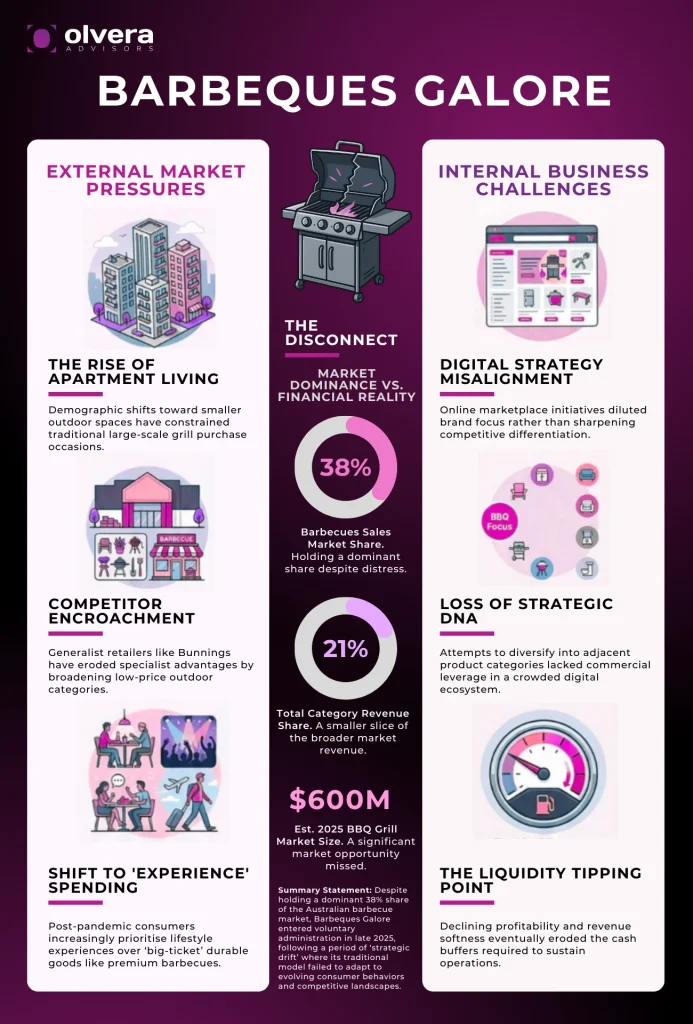
Contrary to narratives of a shrinking barbecue category, independent market analysis indicates continued market expansion but in a different way. The Australian barbecue grill market reached roughly A$450m and is projected to grow at ~5.3% CAGR through 2035. That suggests the category itself is not structurally declining, but consumer substitution is reshaping how value is captured. For example:
- Big-box retailers and scale players increasingly leverage prices below those of specialist retailers.
- Urbanisation and apartment living constrain outdoor space, shifting demand toward smaller or electric grills.
These shifts undermine the traditional “backyard barbecue” value proposition that Barbeques Galore was built on.
Competitive and channel pressures
Barbeques Galore commanded a significant share in its category. But competitive encroachment has intensified. Mass-market retailers like Bunnings and online channels have expanded into barbecue and outdoor products with aggressive pricing and scale logistics. While e-commerce share is diluting the in-store specialty advantage that once insulated incumbents.
At the same time, digital marketplace initiatives, while strategically sound, would have led to higher customer acquisition costs and complex inventory economics without delivering the scale needed to maintain margins.
Changes in discretionary retail
Barbeques Galore’s challenges also reflect macroeconomic spending patterns. Household discretionary spending has shifted toward services, travel and experiences rather than durable goods. While rising living costs have tightened budgets for non-essentials, they have disproportionately impacted mid-tier retailers.
This structural headwind is supported by broader data showing a ~50% increase in retail insolvencies in 2025, with discretionary categories such as furniture and recreation particularly affected.
Leadership, timing and capital structure
In late 2025, Barbeques Galore was acquired by Gordon Brothers, a Boston-based special situations investor, and a new CEO was appointed. Within weeks, administration and receivership followed.
That rapid sequence invites legitimate strategic questions:
- Was this reactive distress management or the execution of a pre-planned restructuring architecture?
- With Gordon Brothers reportedly holding interests across capital layers, formal appointments can be a tactical mechanism to reset legacy liabilities and position for a sale.
Formal insolvency processes confer tools not available to standalone management - from lease disclaimers to creditor compromise mechanisms - that can materially improve balance sheet outcomes.
Stakeholder confidence & consumer signals
Retail insolvencies are uniquely sensitive to perception:
- Suppliers reassess credit terms
- Landlords reconsider occupancy tolerance
- Customers question warranties and gift cards
- Employees confront uncertainty
In retail, consumer trust is key to maintaining consumer goodwill, especially in the high-end discretionary market, and actions that erode trust in a distressed brand are hard to recover from.
The treatment of Barbeques Galore’s gift-card liabilities will become a flashpoint where the receivers have applied conditions requiring customers to spend $2 for every $1 of voucher value, effectively reducing voucher utility to one-third of face value at company owned stores. The programme is not binding on franchise stores creating even greater confusion for consumers.
So where now?
This is more than a single brand collapse. It underscores:
- The fragility of mid-tier specialty retail under margin compression and digital disruption.
- The importance of channel economics in category leadership - where scale and digital optimisation matter as much as heritage brand strength.
- The role of capital structure and timing in shaping outcomes that may look like failure but are, in part, tactical resets.
Barbeques Galore’s failure doesn’t fit a simple “retailer collapse” narrative. It’s a compound case of:
- A heritage brand at odds with evolving consumption patterns
- Competitive pressures from scale players and digital channels
- Liquidity constraints amid margin erosion
- Strategic repositioning and capital-layer incentives
The key questions are not just what failed, but what will continue to work, and how category economics and execution models must adapt as consumer behaviour evolves. We hope Gordon Bros leadership will turn this icon around