On International Women’s Day, we celebrate women’s achievements, including those shaping Australia’s culinary identity. Yet beneath the fine dining acclaim, the lived experience for many women in hospitality remains fractured by gendered power dynamics, harassment, and unsafe workplace cultures that are too often tolerated or swept aside.
Sydney – Australia’s culinary capital – has been at the centre of some of the most serious reporting on these issues. The sheer frequency and severity of allegations involving major hospitality groups has brought the industry’s embattled culture into stark public view – not as isolated incidents, but as symptoms of deeper structural problems.
Women are still a minority in chef roles.
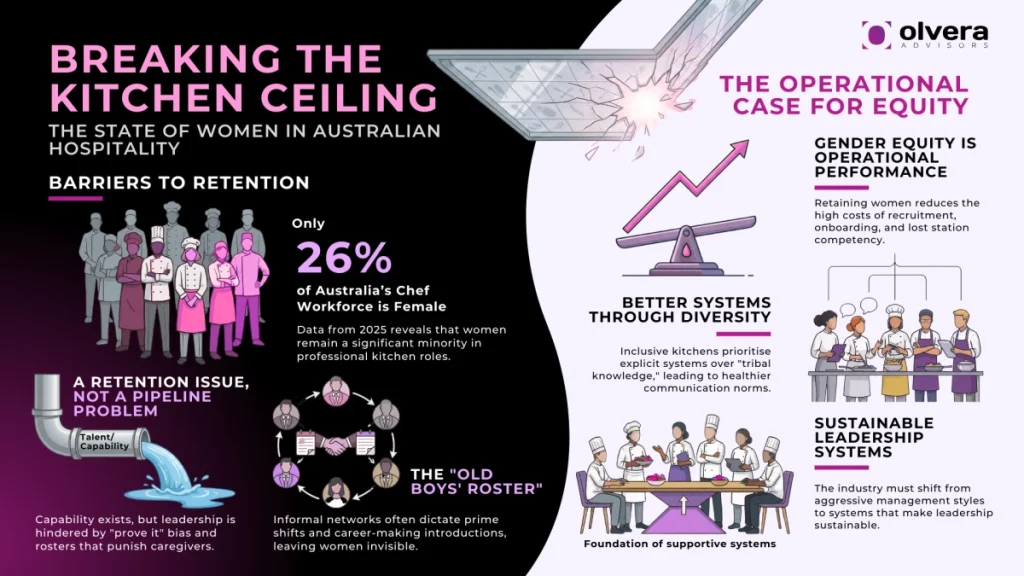
Recent labour market data puts a hard edge on what most of us observe anecdotally, women are only about a quarter of Australia’s chef workforce. Jobs and Skills Australia’s occupation profile for Chefs (ABS Labour Force Survey, Detailed, Nov 2025) shows a female share of 26%.
It’s not a “pipeline” issue. It’s a retention and progression issue. Despite the numbers, Australia has an increasingly visible cohort of high-profile women chefs and culinary leaders across fine dining, regional restaurants, pastry, and food media.
A few names that regularly feature in industry roundups include Danielle Alvarez, Sharon Salloum, Thi Li, Alanna Sapwell, while stalwarts like Christine Mansfeild still command a crowd.
And at the awards-and-impact end of the spectrum, Mindy Woods has been recognised internationally for using food as a vehicle for community and cultural outcomes, becoming the first Australian to win the World’s 50 Best “Champions of Change” award (2025).
These stories matter because they do two things simultaneously:
- They prove capability is not the constraint.
- They make leadership legible to the next generation.
But celebrating individual success without changing the environment is how industries stay stuck. When women chefs talk candidly, the themes are consistent – whether you’re in a 200-seat pub, a hotel brigade, or a 30-seat fine diner.
- “Prove it” bias.
Women are often asked to earn credibility repeatedly, questioned on technical decisions, second-guessed on portioning and timing, or assumed to be “front of house” unless proven otherwise. This is exhausting, and it compounds over years. - The “old boys’ roster”
Too many opportunities, prime shifts, showcase services, investor introductions, media referrals, still travel through informal networks. If you’re not “in,” you’re invisible. - Rosters that punish carers
Kitchen hours are hard for everyone, but the burden lands disproportionately on women because unpaid work at home is not evenly shared. ABS data has long shown women spend more time on unpaid household work than men. Rosters are built as if every chef has a full-time support crew at home. - Harassment, between pressure and abuse
High-performance kitchens can normalise aggression as a management style. It’s not “old school”; it’s ineffective risk management. If you want to keep talent, you can’t run a culture that drives people out. - The leadership bottleneck
Across the Australian workforce, women are underrepresented in senior leadership roles. WGEA’s reporting consistently shows a gap at the top end of organisations. Hospitality mirrors this, women may be present in the workforce but are less represented at executive and decision-making levels, where pay, policy, and culture are actually set.
Gender equity is not charity - it’s operational performance.
Hospitality is running on tight margins. You can’t afford avoidable churn. When women leave kitchens due to culture, inflexibility, or lack of progression, the cost is real:
- recruitment and onboarding,
- lost station competency,
- inconsistent quality,
- management bandwidth diverted to backfilling,
- reputational risk (internally and publicly).
On the upside, kitchens that retain and promote women tend to build:
- deeper bench strength,
- better systems (because they must be explicit, not “tribal knowledge”),
- healthier communication norms,
- stronger employer brand (which is increasingly a competitive advantage).
The truth is simple; Australia doesn’t have a shortage of women who can lead kitchens.
We have a shortage of kitchen systems that make leadership sustainable.