

On 21 March 2026, New South Wales introduced the next phase of its most significant planning reform agenda in over four decades. While the headlines have focused on housing supply and system efficiency, the reform package is an attempt to recalibrate a system that has become increasingly congested, risk-averse and administratively heavy.
Faster Approvals for Minor Variations
The most immediate and tangible change is the introduction of a streamlined approval pathway for minor modifications to existing development consents. Under the amended framework:
- Certain modification applications (particularly those with no environmental impact) must now be determined within 14 days
- These changes expand the scope of what constitutes a “minor modification” under section 4.55(1) of the EP&A Act
- In some cases, if a determination is not made within the statutory timeframe, approvals may effectively be deemed granted, creating a hard discipline on consent authorities
From a practical standpoint, this is a material shift. Historically, even minor design adjustments, documentation corrections, or sequencing changes could trigger reassessment processes measured in months rather than weeks.
The introduction of a 14-day pathway is designed to remove that friction, particularly during live construction phases where timing is critical.
Assessment Times Reduced by Up to 50%
The reform sits within a broader structural change - the introduction of a “targeted assessment development” pathway, designed to bridge the gap between complying development and full development applications. The Government’s stated objective is clear:
- Reduce duplication in assessment
- Remove unnecessary public exhibition where issues have already been addressed strategically
- Focus assessment only on “significant impacts”, rather than all potential impacts
The anticipated outcome is substantial, assessment timeframes for eligible developments could be reduced by up to 50%. This is not simply a marginal efficiency gain; it represents a structural reallocation of planning resources toward higher-risk, higher-impact projects.
A System Under Strain
To understand the significance of these changes, it is necessary to consider the underlying inefficiencies in the NSW planning system prior to reform.
Key data points illustrate the challenge:
- Referrals to additional government agencies were adding 50 days per agency to approval timelines and up to 100 days for multiple referrals
- Approximately 90% of development applications are for projects under $1 million, yet they consumed a disproportionate share of administrative effort
- Minor modifications during construction routinely triggered reassessment processes that disrupted delivery programmes
In effect, the system treated low-risk and high-risk development with similar procedural intensity.
The result was predictable: delays in housing delivery, increased holding costs for developers, greater financing pressure (particularly in a higher interest rate environment), and reduced productivity across the construction sector
A Shift to “Proportionate Assessment”
The philosophical shift underpinning the reforms is arguably more important than the procedural changes. The legislation now emphasises that assessment must be “proportionate to the nature and risk of the development”. This represents a departure from the traditional “one-size-fits-all” model of planning assessment.
In practical terms:
- Low-risk developments should move quickly through the system
- High-impact developments continue to receive detailed scrutiny
- Assessment effort is aligned with actual planning risk
For experienced developers, this creates a more rational framework, but it also introduces new expectations. While the reforms promise faster approvals, they are not a relaxation of standards.
Planning authorities are increasingly adopting a “zero tolerance” approach to incomplete applications, requiring fully developed documentation at lodgement, comprehensive consultant reports, and clear alignment with planning controls.
The system is becoming “faster, fairer, and more predictable, but only where applications are complete and compliant”.
Implications for Major Construction Projects
While the reforms are often framed around minor variations, their impact on major construction projects in NSW is substantial.
Reduced Construction Phase Disruption
Major projects frequently require design and construction adjustments post-approval, including:
- Value engineering changes
- Structural or services coordination updates
- Sequencing adjustments
- Supplier-driven design variations
Under the previous regime, these changes could trigger lengthy approval delays, impacting programme delivery and cost. The 14-day modification pathway materially reduces this risk by allowing rapid approval of non-material changes, avoiding stop-start construction cycles, and improving contractor certainty.
Improved Feasibility and Funding Outcomes
Time is a direct input into development feasibility. Delays in approvals increase interest during construction (IDC), holding costs, contractor claims and variation exposure and equity lock-up periods. By compressing approval timelines, project feasibility margins improve, lenders gain greater certainty on delivery timelines and private credit risk (particularly in construction lending) is reduced.
This is particularly relevant in the current market, where financing costs remain elevated, developers are operating with tighter margins and delays can quickly erode project viability.
Reallocation of Planning Risk
The reforms effectively reallocate risk across the project lifecycle:
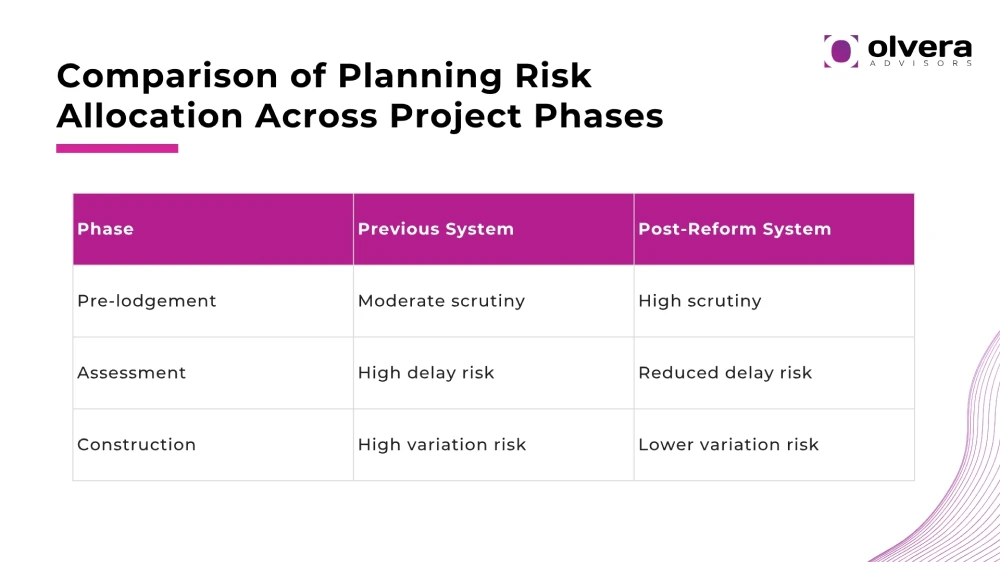
For major construction projects, this means:
- Greater emphasis on early-stage planning strategy
- Increased importance of advisor coordination (planning, legal, technical)
- Reduced uncertainty during execution
Potential Bottleneck Shift (Not Elimination)
It is important to recognise that the reforms do not eliminate delays; they redistribute them. The key risk is that delays shift upstream into pre-lodgement, Councils reject or delay incomplete applications and developers underestimate the level of documentation required.
The Critical Unknown
As with any structural reform, the success of these changes will depend on implementation.
Key questions remain:
- Will councils consistently meet the 14-day determination timeframe?
- How narrowly will “no environmental impact” be interpreted?
- Will targeted assessment pathways be widely adopted or applied conservatively?
- How will the deemed approval mechanism operate in practice?
There is also a broader policy tension in accelerating approvals vs maintaining environmental and community safeguards. This balance will ultimately determine the effectiveness of the reforms.
The 21 March 2026 reforms mark a decisive shift toward a more commercially aligned planning system in New South Wales by introducing 14-day approvals for minor variations, creating targeted assessment pathways and emphasising proportionate, risk-based assessment.
If implemented effectively, these reforms have the potential to:
- Reduce assessment times by up to 50%
- Improve feasibility across a range of projects
- Enhance certainty during construction
- Unlock productivity across the development lifecycle
However, the reforms do not reduce complexity - they reposition it. Success in this new environment will depend on preparation, precision and the ability to navigate a system that is faster, but less forgiving.