
The Subsidy Paradox
Send me the Report
Enter your details and we will send our report straight to your inbox.
$20.9B
Government expenditure on the sector, 2024-25
110–115
Centres into formal insolvency in 18 months
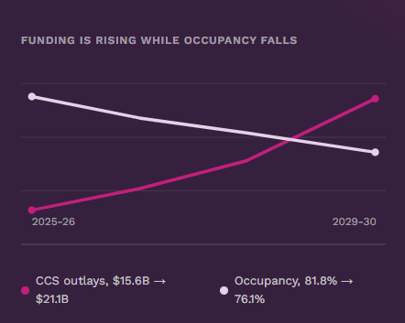
76.1%
National occupancy, December 2025
70.9%
Olvera-modelled breakeven occupancy
Breakeven occupancy now sits at or above the national average, which means a material share of the sector is trading below its own breakeven and financing the gap out of working capital.
Early Childhood Education & Care
Australia is spending more public money on early childhood education and care than at any point in its history, and the sector is failing at a rate not seen since 2008. Both statements are true at the same time.
The reconciliation is a pass-through problem. Incremental public funding is being claimed, before it reaches operator margins, by two parties: a legislated wage settlement that has lifted educator pay well above the pre-reform minimum, and a property model that prices rent per premises rather than per enrolled child - so it never flexes when occupancy falls.
In the eighteen months to August 2026, that combination produced the most concentrated episode of financial failure in the sector since the collapse of ABC Learning: a $303.3 million statutory loss at the largest listed operator, a distressed acquisition, and the administration of a 70-centre network after it defaulted on a single month's rent.
WHAT’S INSIDE THE REPORT
Report insights & key takeaways
WHY THE MONEY DOESN'T LAND
The funding architecture
Why record Child Care Subsidy spending is being absorbed by wages and rent before it reaches operatormargins.
The wage settlement and its trade-off
How a legislated 15%+ pay rise was funded through fee growth caps that now constrain revenue below cost inflation.
WHY OCCUPANCY IS NOW FATAL
The property model
Why rent priced per licensed place - not per enrolled child - turns occupancy decline into insolvency.
The operating leverage model
A single-centre financial model showing exactly where breakeven occupancy falls, and why it now sits above the national average.
WHAT HAS ALREADY BROKEN
The distress record
A dated register of the insolvencies, suspensions and distressed acquisitions of the past eighteen months, including the Edge Early Learning administration.
Where the exposure sits
A entity-by-entity risk assessment across listed operators, private equity platforms, landlords and not-for-profits.
WHAT IS LEFT TO PULL
The restructuring framework and the 2028 cliff
The lease, portfolio and recapitalisation levers available to operators - and why 30 June 2028 governs the sector's trajectory.
About the author
Meet our principal, Kate Barnet.

Kate Barnet
Kate is a well-regarded financial professional and FCA with a 30+ year career in professional services. With strong credentials as a Registered Liquidator, Kate's track record includes working with businesses, lenders, and stakeholders to undertake formal appointments and conduct reviews, investigative assignments and business restructuring engagements.
Kate has been involved in appointments across a broad range of industries, including early childhood education and care, financial services, tourism and hospitality, transport, manufacturing, property and construction, and retail. That childcare experience, and the single-centre modelling behind this paper's breakeven finding, sit behind the analysis set out here.
She has an excellent commercial understanding of key business drivers and ratios, which she applies to improve short-term business performance and longer-term financial viability.